Showing posts with label #starling. Show all posts

Monday, January 1, 2018

12. RSPB Buckenham Marshes

A soggy start to New Years Eve I thought may have doused our plans for wildlife watching. Happily, I was wrong, and once the day had brightened, we headed out to RSPB Buckenham Marshes.

At first, all seemed quiet, with just a few dabbling mute swans and moorhens picking at the wind swept grass. But, as we ventured further, the unmistakable sound of whistling wigeon and the contented honks of conversational greylags reached our ears.

High above, a marsh harrier flapped lazily, not in the mood for hunting. Below, on the marsh, a desert of lapwings showed off their chunky wings, setting off small murmurations of starlings. Each unsettled the other, building tension. At the other end, all was calm with some sleepy wigeon and resting swans, but, as we turned, the sky was full of drama; there were too many things to grab at our attention.

To our left and right, were the incoming formations of greylag geese ready to join their kin on the marsh for the evening. Ahead, were the dark specks of what looked like inverted snow, but were actually a mixed flock of corvids making their way in for their roosting spectacular. To our left was what was building to be a huge starling murumuration; moving as one dark and mysterious superorganism against the sky.


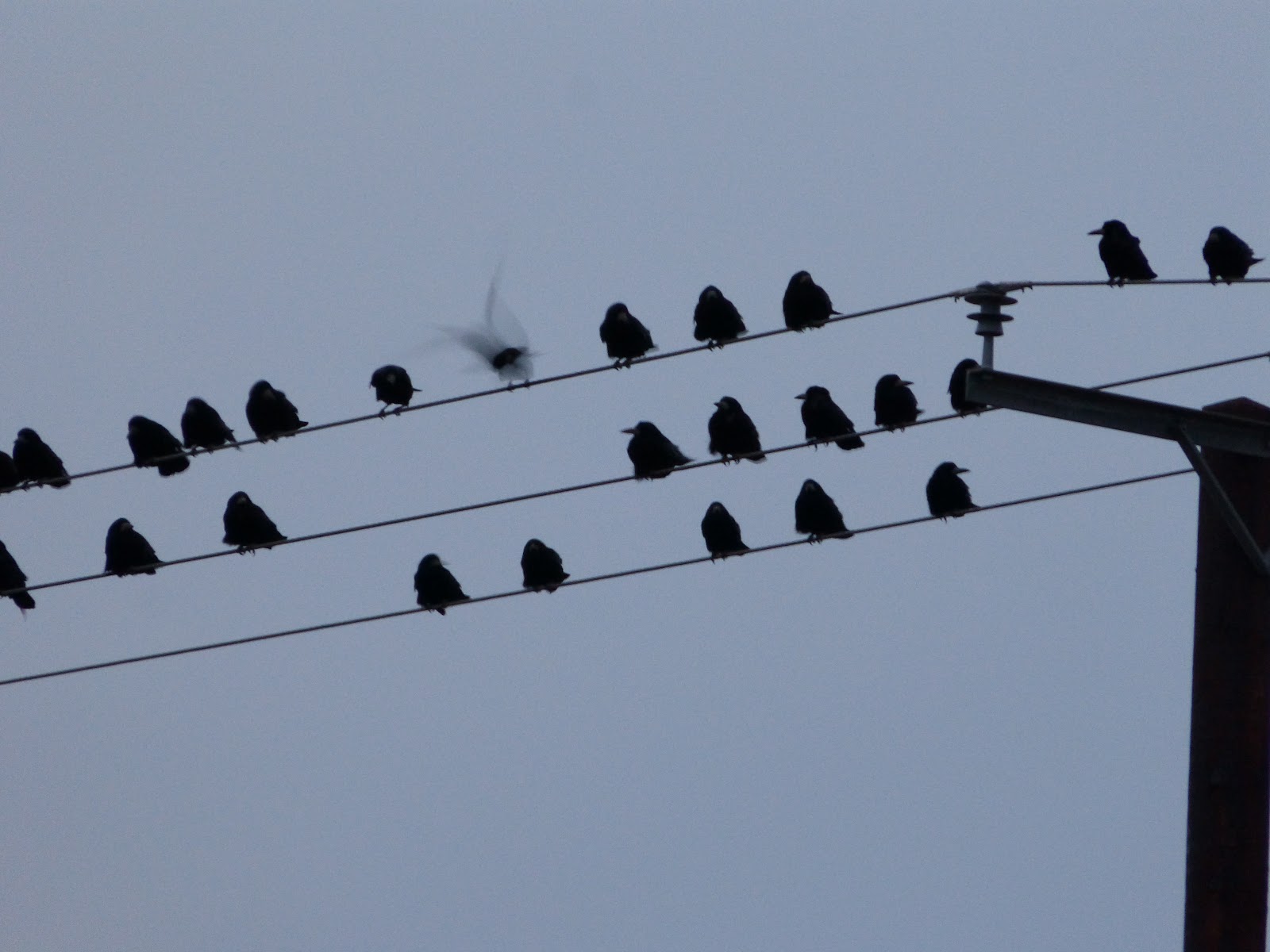
The numbers of rooks and jackdaws swelled as they coalesced in a huge mushroom shaped stand of trees, weighing down it's uppermost branches with their dark forms. Others aggregated on telephone wires before joining the host tree, each new set of arrivals aggravating those already there. When some unknown critical mass was reached, all took off as one, visibly darkening the sky as they headed for the roost site.


What an unforgettable way to end 2017!


Saturday, February 6, 2016

A Week of Big Bird Watches

Three different bird watch events in four days: Big Schools' Bird Watch, Big Garden Bird Watch and Big Castle Bird Watch.

RSPB Big School's Bird Watch - 28th January

This is the fourth consecutive year that I have run the Big Schools' Bird Watch at my school. Our bird watch this year, in numbers, looked like this: 2 teachers, 70 pupils and 99 birds. Our results looked like this:

It may not have been a record year for the number of birds seen, but it was certainly a record for the number of pupils who wanted to get involved! It was great to have so many individuals, most of which did have a genuine interest in the bird watch and nature. However, a few conversations I had with pupils and staff struck a cord with me, and with an article in the February issue of BBC Wildlife Magazine. Why are we so blasé about 'common' species? Or even about locally common species. With my school being so close to farmland, we do get a lot of house sparrows in the local area. Very few of the individuals I spoke to had any idea that sparrow populations have declined so spectacularly on a national level. Hopefully, through the assemblies and conversations I have taken part in, this message may have got through to some. I do think that the Big Schools' Bird Watch was a positive experience for all the pupils that took part, even if some of them did get a little chilly. Hopefully, they all learnt something too.

RSPB Big Garden Bird Watch - 30th January


We carried out our Big Garden Bird Watch on Saturday lunch time, it was a bright and cool day in Norwich and it was nice to watch the birds visiting from the comfort of our flat. It was a busy hour, especially for the starlings! We had RSPB 'bird cakes', 'super suet balls' and mixed seed on offer. This seems to be the best combination of food for attracting a relatively wide range of species to our patch. Since spring last year we have had a healthy number of green finches visiting, I was particularly pleased about this, especially due to their decline in numbers due to the arrival of trichomoniasis in recent years. I am also excited to have finally attracted a regular gang of long tailed tits, one of my favourite British birds, although they were not representing their usual number in this set of data. Our flock of starlings are regulars and, although they take over the entire feeding station when they arrive (intimidating the local wood pigeons), I love watching their squabbling and occasionally comedic antics. They are such beautiful and overlooked birds too, most people I have spoken to recently describe them as 'greedy' and aren't quite as enthusiastic about having them in their area.


The Big Castle Bird Watch - 31st January

I spent my afternoon on Sunday volunteering at the Big Castle Bird Watch; an event held at the Norwich Castle Museum and run by RSPB Strumpshaw Fen. There were lots of activities for the public to get involved with, all of them aimed at raising awareness of the natural world, the dangers wildlife faces, why people should take part in the Big Garden Bird Watch and why they should visit Strumpshaw Fen. My small part of the event was mostly spent encouraging younger children to dress up as a dragonfly and attempt to catch beanbags made into flies in a net. The idea was for them to dart around like a dragonfly would when hunting and give them an appreciation of how agile and maneuverable these amazing insects are. I'm not sure they all took this message away from the game, but they certainly had fun with it!

Monday, January 4, 2016

Christmas and New Year Wildlife

Happy New Year to everyone! Here's a little of what we've managed to do and see in the generally miserable weather over the Christmas break.

We spent the first part of Christmas is Southsea at my in-laws. It was lovely to have some walks by the seafront during the festivities. No migrant birds to be seen this time, but some beautiful house sparrows and starlings around, alongside a talkative gaggle of brent geese. Among the geese were a few skittish pied wagtails.


On the morning of our departure, on a nearby church, perched a peregrine falcon tearing at its meal of pigeon, feathers being blown in the wind after each rip of the peregrines beak.

Just after new year, we visited some friends who live in Sheringham. Another walk along the seafront in a very different part of the country. We approached a rather tame cluster of turnstones. Among this hardy little group though lurked a couple of much shyer purple sandpiper. Not a bird I think I've seen in Norfolk before.


Turning our backs to the sea, we spotted a small murmuration of starlings over the town, which slowly grew in number as the light began to drain from the sky. Multiple flocks appeared which mingled with each other, then separated. We hunted out their chosen roosting spot, watching the flocks shape shift above streets and houses on our travels. It was wonderful to see so many groups of people just stopping and watching the birds' performance. Eventually, we tracked down their chosen spot to a large conifer tree in a back garden and watched some of them stream down from the sky, then jostle and chatter for position. By the time we left, our friends estimated that there were probably in the region of 1500 birds in total.


This has been the only starling murmuration I have seen so far this season, but I have been sure to record it on the starling survey. If you see any, be sure to submit your recordings too.


Monday, June 8, 2015

Fledglings on the feeders

I am a few blogs behind at the moment, but just wanted to share our recent fledgling invasion with these pictures of our green finches and starlings. It's interesting to watch the starlings, it almost seems as if they establish a 'pecking order' as soon as they land and begin squabbling over food. They've also got significantly more confident in the couple of weeks since I took these shots and are now fighting off the adults to get their share!