Showing posts with label #murmuration. Show all posts

Monday, January 1, 2018

12. RSPB Buckenham Marshes

A soggy start to New Years Eve I thought may have doused our plans for wildlife watching. Happily, I was wrong, and once the day had brightened, we headed out to RSPB Buckenham Marshes.

At first, all seemed quiet, with just a few dabbling mute swans and moorhens picking at the wind swept grass. But, as we ventured further, the unmistakable sound of whistling wigeon and the contented honks of conversational greylags reached our ears.

High above, a marsh harrier flapped lazily, not in the mood for hunting. Below, on the marsh, a desert of lapwings showed off their chunky wings, setting off small murmurations of starlings. Each unsettled the other, building tension. At the other end, all was calm with some sleepy wigeon and resting swans, but, as we turned, the sky was full of drama; there were too many things to grab at our attention.

To our left and right, were the incoming formations of greylag geese ready to join their kin on the marsh for the evening. Ahead, were the dark specks of what looked like inverted snow, but were actually a mixed flock of corvids making their way in for their roosting spectacular. To our left was what was building to be a huge starling murumuration; moving as one dark and mysterious superorganism against the sky.


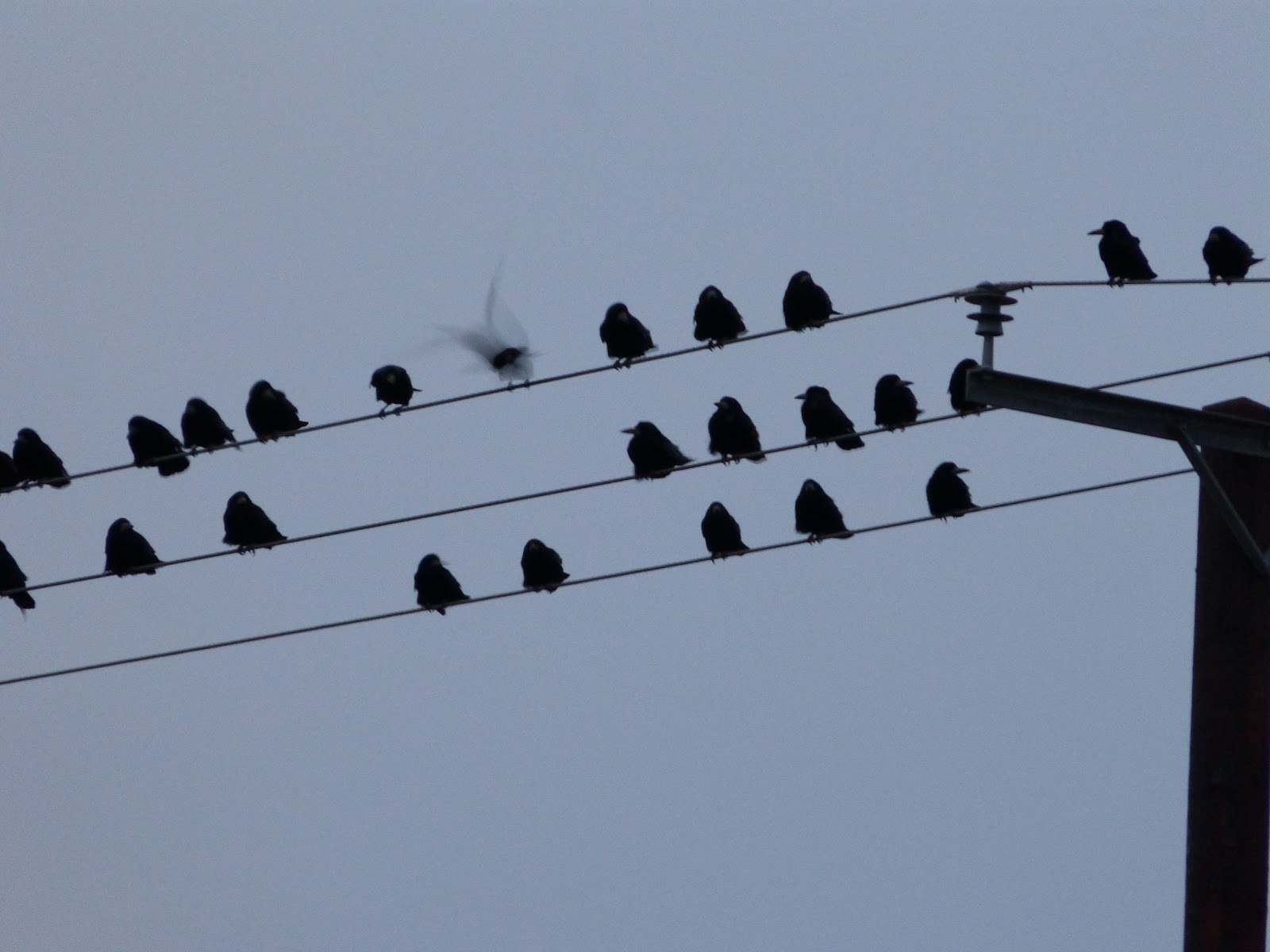
The numbers of rooks and jackdaws swelled as they coalesced in a huge mushroom shaped stand of trees, weighing down it's uppermost branches with their dark forms. Others aggregated on telephone wires before joining the host tree, each new set of arrivals aggravating those already there. When some unknown critical mass was reached, all took off as one, visibly darkening the sky as they headed for the roost site.


What an unforgettable way to end 2017!


Monday, January 4, 2016

Christmas and New Year Wildlife

Happy New Year to everyone! Here's a little of what we've managed to do and see in the generally miserable weather over the Christmas break.

We spent the first part of Christmas is Southsea at my in-laws. It was lovely to have some walks by the seafront during the festivities. No migrant birds to be seen this time, but some beautiful house sparrows and starlings around, alongside a talkative gaggle of brent geese. Among the geese were a few skittish pied wagtails.


On the morning of our departure, on a nearby church, perched a peregrine falcon tearing at its meal of pigeon, feathers being blown in the wind after each rip of the peregrines beak.

Just after new year, we visited some friends who live in Sheringham. Another walk along the seafront in a very different part of the country. We approached a rather tame cluster of turnstones. Among this hardy little group though lurked a couple of much shyer purple sandpiper. Not a bird I think I've seen in Norfolk before.


Turning our backs to the sea, we spotted a small murmuration of starlings over the town, which slowly grew in number as the light began to drain from the sky. Multiple flocks appeared which mingled with each other, then separated. We hunted out their chosen roosting spot, watching the flocks shape shift above streets and houses on our travels. It was wonderful to see so many groups of people just stopping and watching the birds' performance. Eventually, we tracked down their chosen spot to a large conifer tree in a back garden and watched some of them stream down from the sky, then jostle and chatter for position. By the time we left, our friends estimated that there were probably in the region of 1500 birds in total.


This has been the only starling murmuration I have seen so far this season, but I have been sure to record it on the starling survey. If you see any, be sure to submit your recordings too.


Sunday, January 25, 2015

RSPB Big Garden Bird Watch 2015

 This is the third year that I have taken part in the RSPB's Big Garden Bird Watch. It was an action packed hour for me this year, with species I wasn't expecting to see, such as this little wren that was around for almost the entire hour. We also had a record of 28 starlings descending on our feeders at one time, occasionally forming a queue on the fence until there was room for them to join in the squabble for the suet nibbles. It was a record that, when I submitted my results, I was asked "are you sure you saw 28 starlings?" I was very sure. It seems we have cultivated our own miniature murmuration. Our other records this year were:


  • Collared dove - 2
  • Wood pigeon - 2
  • Dunnock - 1
  • Blue tit - 2
  • Great tit - 2
  • Robin - 2
  • Magpie - 2
  • Blackbird - 2


One of our robins is very territorial; not only did it chase off the other robin, it dive bombed the poor dunnock unawares, and they ended up rolling on the ground before the dunnock flew away.

Most of these are our usual visitors, but there are some that I would have expected to see and didn't; for example, we often have one of two coal tits who visit at this time of year. In spring and summer, we also usually have a pair of green finches and a number of gold finches, and we have even had a great spotted woodpecker and his youngsters visit our feeders. It got me thinking about how our results change from year to year, and whether this would depend on the food sources we provide, which have also changed as I have learnt more about what is on offer and what certain species of birds seem to prefer. This year, as we have consistently for several months now without changing food sources, we provided the following foods: sunflower hearts, mixed seed, suet balls, suet nibbles and meal worms, as well as fresh water.

As I was intrigued, I decided to look up my previous two years' results, and have plotted the somewhat rudimentary graph below to compare my findings. It would seem that providing suet nibbles has done wonders for the number of starlings we attract...


Tuesday, November 11, 2014

A Murmuration of...

Wondering where to go on Sunday to enjoy the glorious weather and the great outdoors, and to see a wildlife spectacle I had never seen before, I saw a tweet pop up from @RSPBMinsmere about their 50,000 strong murmuration of starlings. Decision made.

On arrival, we were helpfully told where to be and at what time we should be ready to view the spectacle. It left us with an hour to enjoy at least a small part of the reserve. We headed to the 'Island Mere Hide', where there had been earlier reports of otters and bewick swans. We saw neither, but were entertained by the huge rafts of coots, a few diving cormorants and a little blue tit intent on stripping bare one of the rushes. This little bird stayed there, continually pulling away at the 'fluff' the whole time we were in the hide, and after we had left.
 We made our way back to the 'Bittern hide' for 3:30 pm, ready to watch the starlings gather and begin their display. Despite being early, the hide was almost full when we arrived, and there was certainly no seating room available. We waited and waited. After there had been no movement, except for the occasional call from a hidden Cetti's warbler, we decided to head outside and take our chances watching outside the hide, dodging either side of tree branches obscuring our view. The afternoon had been so clear and bright that the starlings took a long while to begin their mesmirising display. Eventually, we saw a flock of black dots moving against the orange glow of the sky, and the white glow of Sizewell B power station in the distance. Humble beginnings for such a majestic display. We kept watch. Eventually, the sky behind us became filled with the sound of wing beats, a rush of wind, and a flock flew over our heads and over the hide across the wetland to join the already thousands-strong murmuration traversing the horizon. More, and more, and more smaller flocks joined the larger flock, until I was sure there were more than the 50, 000 reported the previous day. They danced across the open sky, this way, that way, creating wave like movements as each bird adjusted its position to those next to it. The marsh harriers who had been waiting patiently, like we had, drifted close to the edges of the murmuration, hoping for a starling snack. We saw none get caught.

A beautiful sight, a 'tick' for both of us, and that contented feeling of having seen something truly special, one of nature's spectacles.