Showing posts with label #birdfeeders. Show all posts

Wednesday, April 5, 2017

7. Sculthorpe Moor

A gloriously bright day, feeling truly like spring, with chiff chaffs calling from every bush and tree, or at least that’s how it felt. Their humble song, announcing their name, whilst mostly staying hidden amongst twigs, new leaves and catkins, accompanied us on our walk from reception to the reserve entrance. A viewing panel overlooking long feeders was our first stop. Drawing back the shutters, we were greeted by a male bullfinch in full colour, his deep red feathers shining out like a jewel from the feeding station.

M. bullfinch
F. reed bunting

Following the boardwalk, through the woodland and over ‘watervole bridge’, although we saw no water voles, a pair of marsh tits alighted in a low tree, their completely black caps contrasting with the brightness of the day. When we arrived at the woodland hide, at first, all was quiet, with little to be seen or heard. A pair of muntjac deer skulked along the shadows, occasionally dashing through sunlit patches, dining on new shoots and leaves. Chaffinches, both male and female, began to descend, balancing on feeder perches and gathering on the floor below. A female reed bunting joined in, flitting from tree to ground and back again, her yellow and chocolate brown stripes seemingly out of place in the woodland. A pair of green finches dined, serenaded by the fluting and slightly scratchy song of a male black cap.

Leaving the woodland hide and continuing on the boardwalk towards fen hide, a commotion began above us. A pair of very agitated great tits shouting at a pair of nuthatches paying too much attention to a particular nest box; they continued their harsh calls until well after the nuthatches had flown. Perhaps a war over a as yet unoccupied box? Or the nuthatches trying to invade?

Fen hide was bathed in sharp sunlight, reflecting prettily off the ripples made by the little grebes, mallards and coots. The little grebes had a small nest right in front of the hide, almost invisible until they shifted vegetation, exposing a clutch of eggs, then carefully covering them over again before heading back out to forage. A pair of doves and a selection of male reed buntings had ownership of one bird table, whilst the other was swarming with more reed buntings and bramblings, with the occasional visit by a long tailed tit, bullfinch or nuthatch.


M. reed bunting
Little grebe

The newest hide at the reserve is the tower hide, built so as to be level with the canopy. Here, we had amazing views of the small birds brave enough to alight on platforms close to the hide windows. Today, a brambling was one of them, as well as an acrobatic long tailed tit, who would steal a morsel of food, hang from a twig with one claw whilst gripping the morsel in the other and feeding from it. A red poll, less brave, but no less attractive, sat on a niger seed feeder slightly further away.

Brambling
Red poll
Long tailed tit
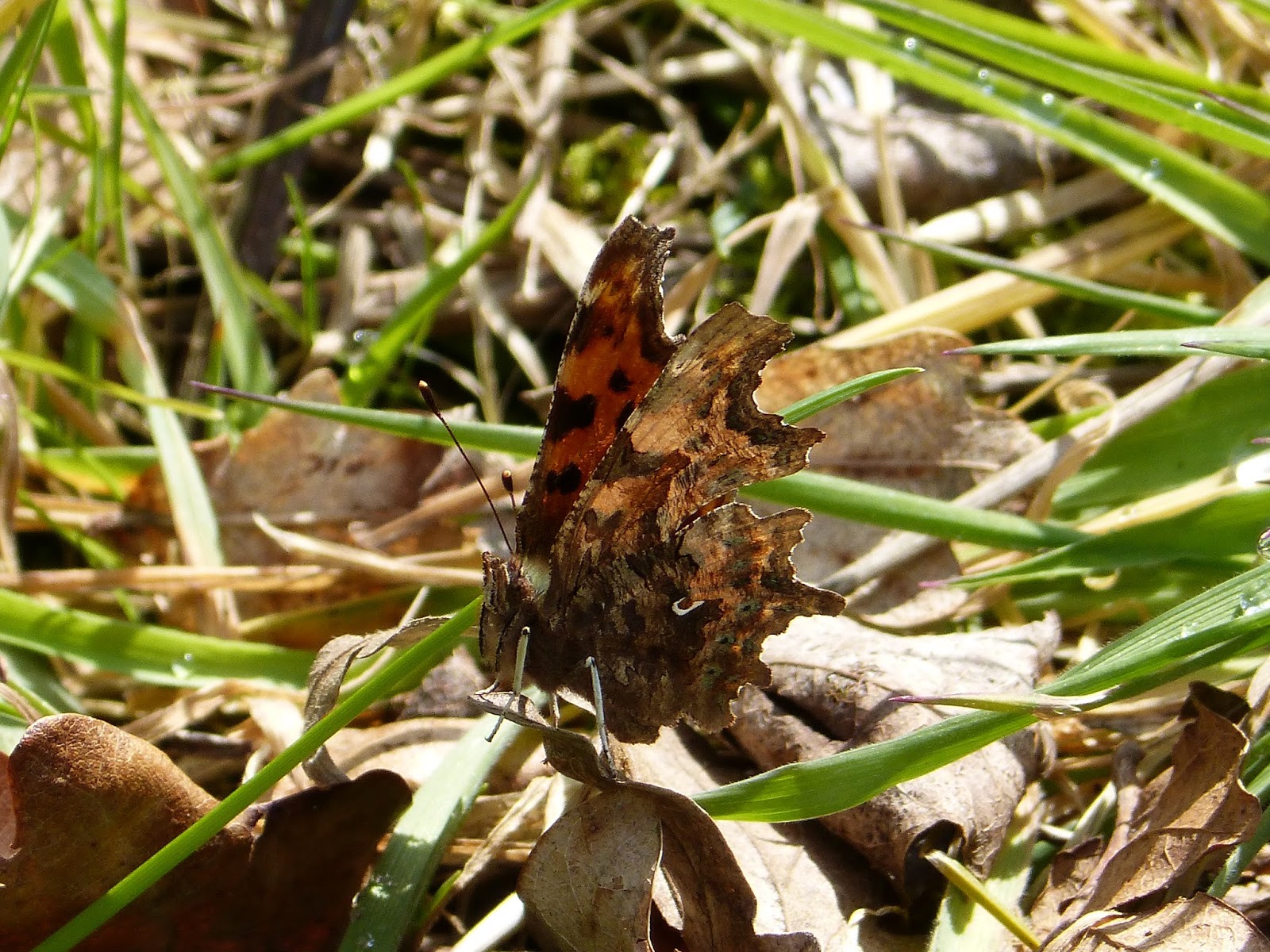
Peacock butterfly

We continued, walking along the boardwalk bathed in sunlight, towards the scrape hides, where, unfortunately, there was nothing to be seen, but a green woodpecker could be heard yaffling from nearby. The warm day had tempted out a few different butterflies; an orange-tip gliding along the path edges and peacock butterflies basking on the boardwalk or chasing each other in spirals.


A day to herald the arrival of spring.

Saturday, June 4, 2016

#30DaysWild - Day 3 - Sketching


I ran a revision session at work this morning and the weather was drizzling again. When I returned home, I walked through the park opposite our house and revelled in the scent of the wet soil. The hawthorn trees are in full blossom and the huge oak tree is a beautiful deep green. 

Later on, I found time to illustrate one of my nature diary entries from the last couple of days; one of our very cute pied wagtail fledglings, of which we have now seen three.


Sunday, April 17, 2016

Some familiar places and a new local patch!

It's been about six weeks since my last blog update - it's been a bit of a busy time! We moved house during the Easter holiday and are settling in. That means we've said goodbye to our old local patch near the River Wensum and have a new local patch not far from the River Yare. In this update, I'm hoping to sum up our time at our old patch, introduce our new patch and take a tour of a familiar places during the mean time.

The old patch

We've lived in a flat in Norwich close to the River Wensum together for about 3 years. In that time, we've set up bird feeders in the communal gardens - attracting and sustaining quite large numbers of particular species (especially starlings and green finches). In the process we also accidentally created an ideal home for a family of wood mice in hole just beneath the feeding station. On walks around the patch, we've seen otters, woodpeckers, kingfishers and many woodland birds. Although most of the more uncommon species only showed themselves when I wasn't carrying my camera! We've seen a lot of wildlife in what we thought was an unlikely place in the city. I hope that our small population of birds will find ample food sources without us (I'm sure they will). We've also seen lots around our usual wildlife adventure areas, of which we've managed to visit a couple during the moving process...

Foxley Wood - 8th April

Just over a week after we moved to our new house and a few days before returning to work, we decided to escape the boxes, sorting and shopping and go on a hunt for bluebells at Foxley Wood. I had been hearing reports of early bluebells and didn't want to accidentally miss one of my favourite wildlife spectacles. It was a beautifully sunny day, but we hadn't considered quite how wet and muddy it would be after the thunderstorm the previous evening. It prevented us from reaching the bluebell hotspots, but we took comfort in that the patches of bluebells we did find were just coming into bloom. There should be a chance to go back before they are over. Pretty white blossoms adorned some of the trees and the sunshine had brought out a myriad of butterflies: brimstones, commas and peacocks basking and skimming over the unkempt grasses at the edges of the rides. A chiff chaff called in the background, heralding that spring had arrived with him. We stopped before the path became unpassable and listened: a buzzard calling in the background, tits and finches calling too each other. A sense of calm in the chaos of the last few days. 


Our new patch

We're not actually that far away from our old patch, but we are now in a house in the suburbs of Norwich. That means I now have a small garden which is pretty much just lawn at the moment - I'm itching to get started on transforming it into a wildlife haven. The very first thing we did when we arrived (and I really do mean the first thing!) was to put up our bird feeding station and fill it full of the normal delicacies. Not expecting anything for at least a few days, I was pleased that it had been found by a magpie, a pair of collared doves and a pair of woodpigeon within the first day. Not my intended audience, but still a good start. There is a park and a small woodland opposite the front of our house and when hanging washing out (is it sad that I am excited that I can do this?!) I can hear blue, great and coal tits, chaffinches, green finches and gold finches, even a chiff chaff and a green woodpecker, so I knew we'd get some smaller birds eventually. We've now been here for just over two weeks and we have regularly visiting birds which are slowly growing in numbers. The first were a pair of blue tits, then a pair of great tits, now we also have a pair of chaffinches and a robin. Hopefully the other birds I can hear will find their way across too. On walking around our local patch, we've discovered, to our delight that we can walk through the small woodland, which is absolutely filled with bird song. There is a mixture of mature and young trees and daffodils and English bluebells have been planted beneath them. The park leads to a path. On the corner, amongst a few trees, I have found a pair of nuthatches in the same place three times. I've decided I am going to call this 'nuthatch corner'. They are clearly used to people passing because on the third occasion, I took my camera and managed to get some decent shots of one of them.

 I'm hoping to keep updates of the new birds and other creatures that visit our garden and local patch and a record of my wildlife garden improvements - suggestions for plants are most welcome!

Sunday, February 14, 2016

Pochard at Pensthorpe

Sunday 7th February 2016

It was a cold and windy day, cloudy with some sunny spells. We might have been frozen, but the waterfowl didn't seem to mind too much. I have a soft spot for tufted ducks, I'm not sure if it is due to their attempt at a rebellious hair style, their lemon yellow eyes or their daintily sculpted beak, but I do like these little diving ducks. I'm always equally fascinated by the elaborate feet of the coot, the one pictured below tolerated my close proximity and just kept munching on grass as I photographed it. Somewhat less easy to capture was a decent shot of the small raft of pochard on 'Old Squaw Lake', all were hiding their heads under wings and hiding entirely under trees. A couple eventually ventured further onto the open water, showing their bright berry red eyes.

Tufted duck
Coot
Pochard
As much as I admire these three bird species, they were not a surprise to find here. One very surprising find was a smew (red head) on the same lake. Now, Pensthorpe do have smew in their collection, but their captive birds are found on the Mill Pond not far from the conservation shop. It is a possibility that this individual had snuck through the fence, but there was no way of seeing whether it was ringed as its legs were below the waterline... But, I can still hope that this was a wild individual rather than an escapee.

Our walk today was brisk, trying to keep warm in the chilly conditions. We made it to the woodland hide where there were woodland birds in abundance. I have written before about my hunt for a nuthatch as this is one of the few places where I get to see them well. Luckily, one did show itself to feed and perch on the trunks of surrounding trees. They can be domineering over the bird feeders, but they are beautiful birds with their dusky blue backs, apricot blushed breasts and black bandana around their eyes, making them look like bank robbers of the bird world.


All of the hides were deserted, maybe it was that we were relatively early visitors, or whether the cold conditions had put others off, it was nice to have them to ourselves. After an equally brisk walk through the woodland and around the the wildflower meadow, we made our way to the wader scrape hides. These hides are often all-or-nothing when we visit, but today was pretty spectacular. When we arrived, there were a good number of lapwing (for which I've just discovered the collective noun is desert or deceit!) alongside teal, wigeon, shelduck and others. Suddenly the flock lifted and scattered and to our amazement, a peregrine falcon sped into view and vanished almost as quickly as it appeared. Whether it was just passing and wasn't hungry, or was just scattering the birds for its own amusement before passing through, is anyone's guess.


Sunday, November 29, 2015

November at Sculthorpe


Sculthorpe Moor - 15th November

Apologies for not writing for over a month! November has been a busy one, but we did manage a couple of wildlife watching sessions. We have finally made it back to Sculthorpe Moor; this small site run by the Hawk and Owl Trust really is a hidden treasure. We haven't been here since spring and this return visit certainly wasn't a disappointment. The winds we have had throughout November made the trees talk and sing and with it, the bird life joined in.

On first entering the reserve, there is a viewing panel overlooking a range of birdfeeders. They were alive with green finches, chaffinches, great tits, blue tits, coal and marsh tits, a nuthatch and some beautiful bramblings on the feeders and on the floor below. 


Walking around the reserve, it wasn't just the bird hides that yeilded fantastic views of wildlife. On niger seed feeders suspended from trees were dozens of gold finches in dazzling colours. In trees above were mixed flocks of siskins tweezering out seeds and chattering away to each other with goldfinches trying to join in the conversation. There seemed to be long tailed tits everywhere, one of my favourite bird species, always sociable and 'friendly' in their large gangs, filling the air with their 'see-see-see's. 


The new elevated hide in the reserve gave beautiful close up views of these rosey-pink socialites and a tree creeper amid their chattering and the flocks of gold finches. We also had long distance views of gliding marsh harriers quartering the reed beds below. At the Fen hide we found a little grebe nestled among a quartet of mallards. A male bullfinch took over one of the feeders and bullied other birds away, claiming the seeds for himself. 

Another wonderful visit to this reserve. Hopefully we'll not have to wait another 6 months before we visit again!

Sunday, September 6, 2015

Last weekend of summer

So, we're back at school. Fortunately, last weekend, I made the most of the freedom and spent a lovely couple of days at Pensthorpe and Strumpshaw Fen with friends as well as walking around our local patch and admiring the hordes of birds that have been visiting our feeders.

For birds and other wildlife, our local patch was quiet. However, in the late summer sunlight, it was a beautiful sight across the River Wensum and the surrounding trees.

Surprisingly, our bird feeders have been a hive of activity throughout August; the complete opposite to what I would have expected. Flocks of 20 strong long tailed tits have been visiting alongside groups of greenfiches, chaffinches, blue tits, great tits, starlings, sparrows, coal tits... and a sparrowhawk!


The sun was shining and the waterfowl were out in force at Pensthorpe, as well as the small tortoiseshells and red admirals, dazzling with their fiery wings and occasionally sharing flower heads with horse flies. There were also swallows and house martins cutting through the air at speed and occasionally settling, but not for long. It was almost possible to feel their restlessness as they ready for migration.


The weirdest thing we spotted was at a river crossing. Just below the surface, sunning themselves on the silted river bottom were dozens of signal crayfish of all sizes. Alien and almost dastardly looking with their odd claws and segmented bodies.


The following day at Strumpshaw, the conditions were very different - blanket cloud smothered the sky despite it still being warm. It was a poor day for invertebrates (we didn't see a single butterfly), but a fantastic day for birds. We took the Meadow trail and my attention was immediately caught by a calling great spotted woodpecker foraging beneath the bark of a dead branch. I then very nearly trod on a common froglet, who kindly posed on a pile of dung.

We gradually made our way through the mud to Tower hide. We were greeted this time, not with a chorus of lapwings, but with a gaggle of greylag geese, knot, shoveler, teal and other ducks, a kingfisher, common terns, grey herons, little egrets and a great egret. The first confirmed sighting of a great egret in the UK for me. We sat and watched the little egrets display, with one (the male, we think) being somewhat keener...


Fen hide was next on our list, so we back tracked and took the turning. We were very glad we did. Here, the small jewel of kingfisher granted us good views as it flitted from reeds to post and back again multiple times. Marsh harriers kept their distance, but visibly quartered the reedbeds below. Chinese water deer chased each other through the clearings between reed beds, but the light grew too poor for photographs very quickly. Hopefully now autumn is (nearly) here, I might actually get a photo of these quirky looking animals...


Monday, June 8, 2015

Fledglings on the feeders

I am a few blogs behind at the moment, but just wanted to share our recent fledgling invasion with these pictures of our green finches and starlings. It's interesting to watch the starlings, it almost seems as if they establish a 'pecking order' as soon as they land and begin squabbling over food. They've also got significantly more confident in the couple of weeks since I took these shots and are now fighting off the adults to get their share!