Sunday, January 22, 2017

Women's March on Washington

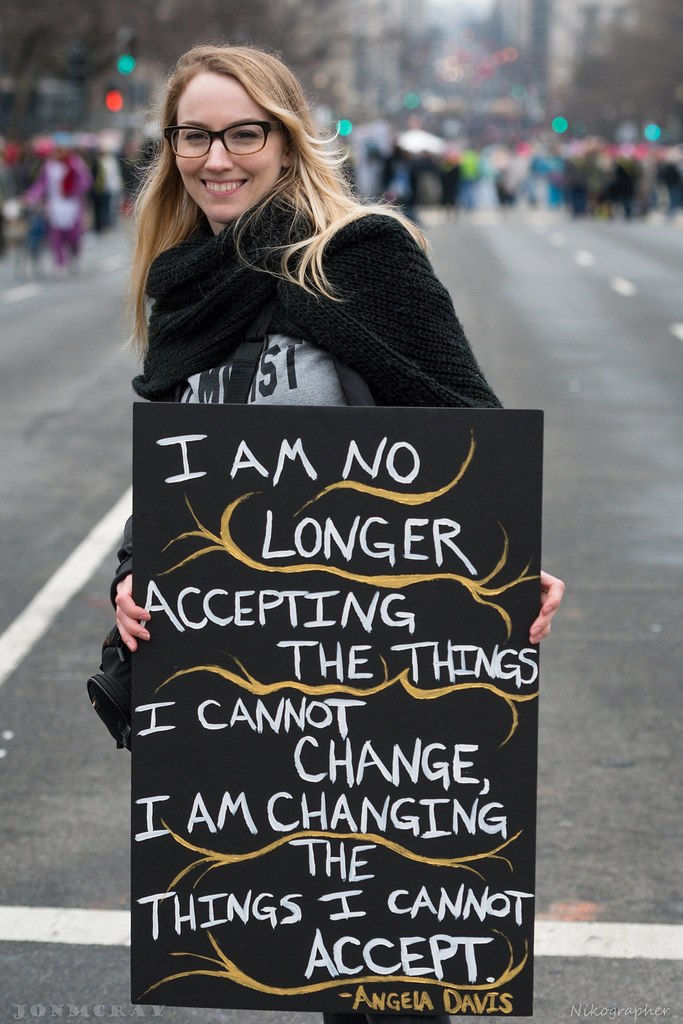
The day after the inauguration of Trump, there was a rally in Washington DC - the Women's March on Washington.

Normally I take photos of nature, animals, and occasionally friends and family. But I have lived near Washington DC for almost 20 years, and I have never photographed any significant or historic events in the area.


A photo posted by Jon (@the_real_nikographer) on

Recently I have been open to trying new things, as I did with my trip a couple weeks ago to Jackson Wyoming.  Attending a crowded rally in DC, planning for the logistics of shooting there and the uncontrolled/unknowable aspects of being on foot during such a busy time has in the past made me decide to do other things.  But not this time.

So I got up at around 5am, and made to a parking area off Ohio drive behind the Jefferson Memorial around 6:15am and then waited.  I was unsure what to expect even with this small aspect of the day, where and when to park.  But when I got there the lot was nearly empty, heck it was an hour before sunrise - nothing new with regards to planning and traveling for wildlife and sunrise - but the lot could have been closed, the road access could have been closed or diverted, a ton of things could have made this first step a problem  But luckily it worked out.

A photo posted by Jon (@the_real_nikographer) on


I got to the lot and then rested a bit, and was reassured by this first step working out.  Then I walked to the Jefferson, and was the only one there - an odd and eerie thing.  The capital would be over run with people in the hours to come but this was the calm before the so called storm.  I tried to use the facilities there but they were accessible but closed for repairs.

As dawn approached I walked over towards the Washington Monument, it was foggy and damp out.  And there were a few others also getting a jump on the long day ahead (not pictured in this shot).

A photo posted by Jon (@the_real_nikographer) on


On Friday I called the park service to see about the march, routes, access and restrictions.  What I learned was that there would be restrictions and security for those inside the protected area (whatever that actually meant).  But that throughout the rest of Washington D.C. it would be just like any other day and there would not be blockades, or checkpoints, or heightened security.  So I took a backpack that was too large for the restricted areas never intending to go inside a restricted area.

As I got closer and the morning progressed, I realized that there would people everywhere and I would be able to see "the event" from all over the place.  I walked down the Mall and then south on 4th street (I think).

During the entire day I took about 2,700 photos, and walked 10 miles.

A photo posted by Jon (@the_real_nikographer) on


For the most part I managed to remain on the edges of the crowds and assembling marchers.  However a few times I had to "retreat" to get to less crowded areas.  One time a couple of guys took the baracades along 7th street and made an opening so that the people in the street could easily move to the sidewalks and grassy areas.  Most people continued to move towards the Rally area, but within a short time the area was nearly packed with those that didn't want to move closer and wanted a spot to rest.

Another time at roughly 7th and Independence I stopped to shoot the crowd from in front of a jumbo-tron type display.  There was space in front of the display because the angle from right in front of it was too oblique to be able to see the screen.  However even that spot filled in as more people moved in to the area and gathered.  I managed to shoot a handful of images facing the crowd from this spot and it worked well.  I also got up a couple feet by standing on something to get a better angle on the crowd - though it was an awkward spot and eventually after I had move off a person asked those nearby not to stand there (on it) anymore.

And later when the intersection of Independence and 15th street was in the preparing stages of the actual march proper, I managed to I guess look like a press photographer and stayed IN the intersection along with organizers, police and actual press photographers.  I took the time to shoot photos and talked to everyone there. It felt like one of those act like you belong moments and it worked out.  Everyone was friendly and I even chatted it up a bit with a particular press photographer from New York city.  He seemed like a seasoned veteran of the trade and was nice and had some interesting quips about the day that I appreciated - such as some background on the "American flag hijab" thing, which he said started in NYC.

A photo posted by Jon (@the_real_nikographer) on


This type of photography is new to me, and I have been trying to find a way to show meaningful moments from the day.  I realize that I could post photos from throughout the day and that various messages marchers had would be seen via their signs and actions, and the images would invoke various responses.  I don't usually try to express my own political leanings through my photography, and I am mindful of which images I choose to share.

With that, here are a couple of images that are a start to my selecting and sharing meaningful images:

Granda
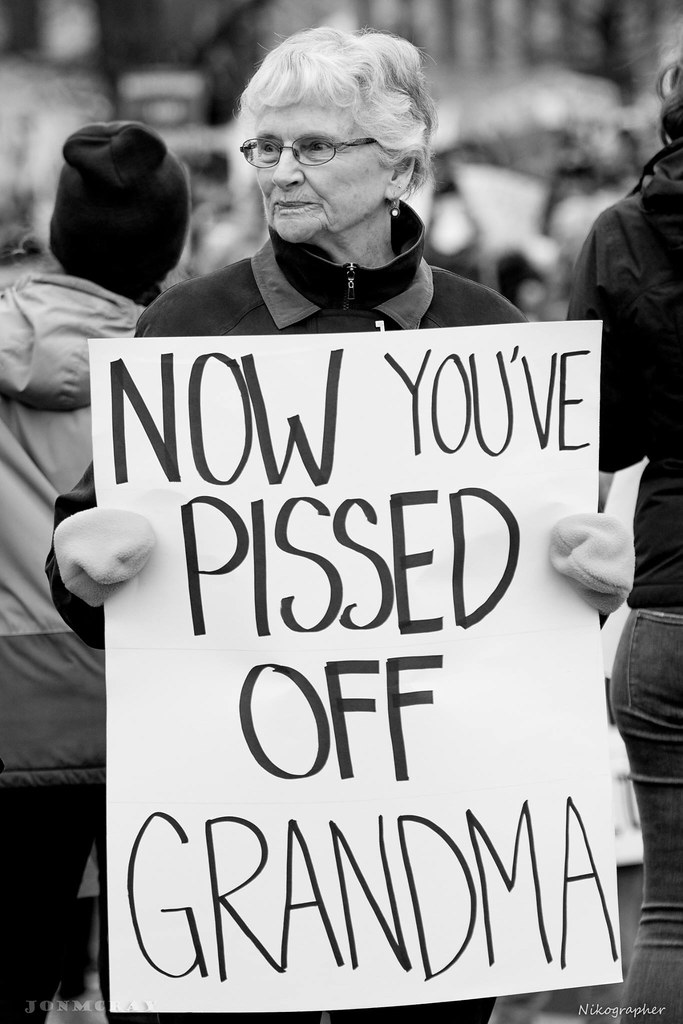
Grandma @ Women's March in Washington DC.

Hijab
WMW 2017

-
With that, I will add images to this post as I process and share more images.

update 1 - 2 new images

I took a lot of portraits of those at the rally, there were some really interesting looking people.  I used to setups while at the rally, D500 w/ 70-200mm f/2.8 and D810 w/ 17-35mm f/2.8 (I swapped lenses between those 2 bodies a couple times).
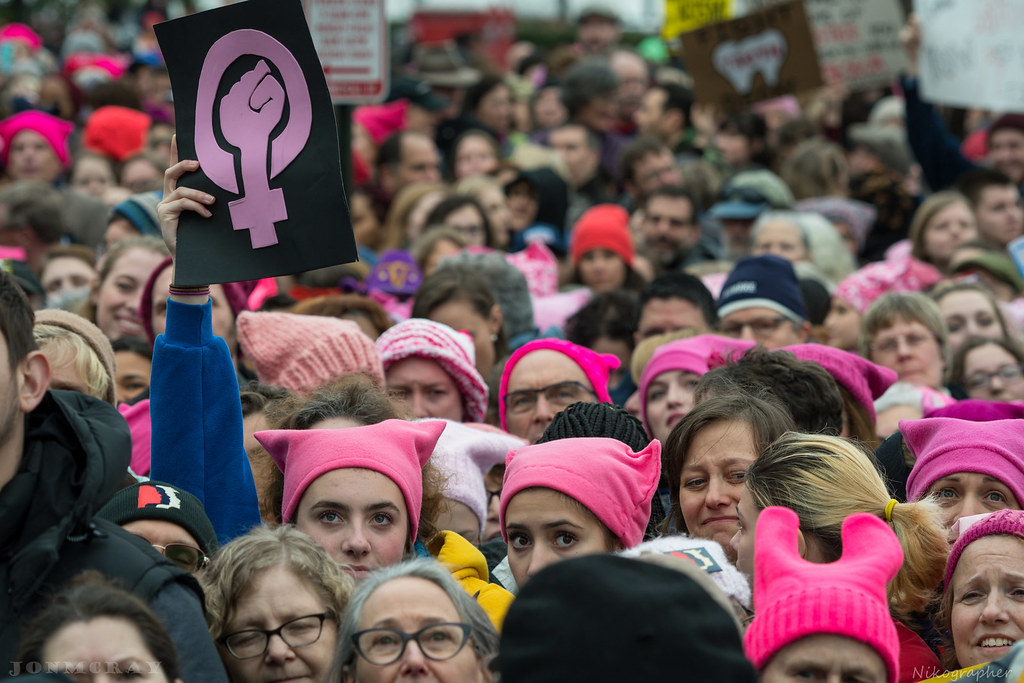
Faces in the Crowd @ Women's March on Washington

Portrait @ Women's March on Washington

update 2 - A couple more photos...

@Women's March on Washington

Women's March on Washington


Update 3
Two more images from the march, there was a genuine positive attitude at the march.  People were excited to express themselves and to get their message out there.  Everyone wanted to be seen and to have their voices heard.
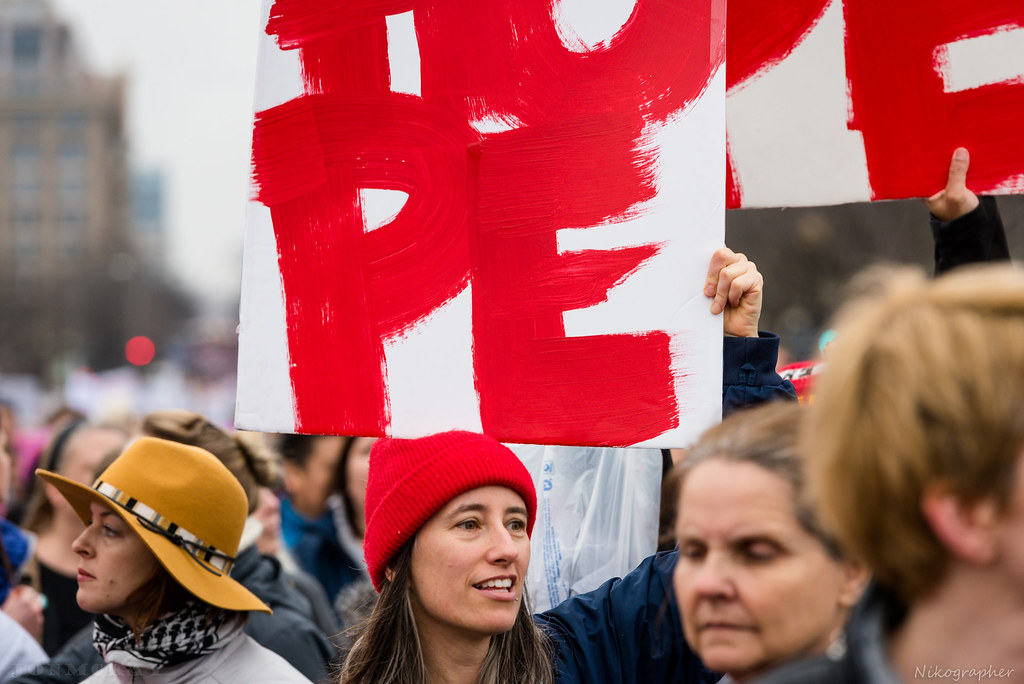
HOPE

ERA YES


-Jon


2. Lower Wood, Ashwellthorpe

The Sun’s rays scattered by ice covered glass and grass turned into cake 
frosting; white, hard and crunchy under foot, it was a frosty winter’s morning in Norfolk. Parking at the medieval church in the village, birds could be heard calling from the suburban trees, surrounding fields and woodland. The short walk to the reserve was pleasant, a small distance along the road, then a public footpath along the perimeter of a field. The mixture of open landscape and woodland was a contrast that seemed popular with local birds of prey. A pair of buzzards took flight, greeting us upon entering the woodland over a small bridge. No sooner had we entered the woodland, and we were surrounded by smaller woodland birds calling and scattering, as well as a few chattering grey squirrels and a roe deer, before it caught sight of us. The tiny goldcrest imperceptibly moving from twig to twig and a treecreeper, somewhat more confiding, winding its way up the bark of trees nearby. 


Following the NWT arrows took us around the edge of this small reserve, with robins, blue- and great tits traversing the walkways ahead of us. Great spotted woodpeckers could be heard calling, but did not make themselves known by sight. A kestrel silently glided, carving the skyscape with long tail and arrow like wings, landing gracefully in the bare canopy. The coppiced trees provide ample cover for small birds with their almost impenetrable vertical swords of thin branches, closely packed. Larger trees twisted their gnarled trunks skyward, their asymmetry pleasing to the eye. Every tree, it seemed, filled with the calls and songs of woodland birds. As we completed the trail, a treecreeper was again at the entrance to bid us farewell.


Saturday, January 14, 2017

Even from a Stone - Something can Grow


I went to Shenandoah National Park 3 times in 2016, and was struck by this wall and the things growing in it.

Today I was reminded of this image. 

Even from a Stone 

There is hope and determination in these plants. 

What is now almost a couple weeks ago, I had an experience that has stuck with me, and has had a strong impact on the way I see things, and the way I reflect on the choices I have made.

Life is not a sure thing.  Tomorrow is not a given.  But we live like both are guarenteed to happen every morning when we wake up.

I got a glimpse in to something truer, briefly.  Part of me is afraid that this new insight will fade away, and I will go blissfully on expecting to get a chance to do more, to live another day, when really today is the day to live in.

What do you think?  Do you take tomorrow for granted?

1. Whitlingham Country Park

On the coldest weekend of the winter so far, when tidal surges had caused parts Great Yarmouth and other coastal areas to be evacuated and many reserves were partially underwater, we tried our first new area of 2017: Whitlingham Country Park.

The forecast had been for snow and sleet most of the day, but, thankfully, the sun shone brightly in a crisp, blue sky all afternoon. We arrived at the park for the final hour of daylight, hoping the cold snap had brought out foraging birds, including winter visitors. Walking briskly to fend off the cold, we took the circular walk around Great Broad. A pair of Egyptian geese plucked at the grass and called softly to each other as we passed. Great rafts of tufted ducks, accompanied by gadwall, pochard, coot and the odd great crested grebe drifted with purpose, diving below the water. Canada and greylag geese, patrolled the margins of the broad, accompanied by several pairs of mute swans.

As the Sun sank further, there was something delicious about the way the light illuminated the water’s surface, putting a spotlight on the wildfowl that danced both below and above the pool of watery winter sunlight; the reeds the fairy lights to guide visitors along the water’s edge. Silhouettes of long tailed tits flitted restlessly in the leafless tall trees, calling to other members of the gang as they flew. Blue tits, as high as they could be, their yellow breasts highlighted by the last rays of Sun. A grey heron glided along the bank, broad wings outstretched. A flock of green finches performed over the broad, settling into a naked tree, decorating its branches. Cormorants adorned yet other trees, settling far apart. A wonderful end to a wintry day.

A Challenge for 2017

Late last year, I ran out of time to update my blog often, but that doesn't mean we weren't out and enjoying the sights and sounds of wild Norfolk.

This year, I've decided to set myself a challenge. I love the reserves we visit regularly, but I haven't discovered anywhere new for a while. This year, I would like to visit as many different reserves in and around Norfolk as I can, hopefully with the added bonus of increasing my life list of species and my identification skills.

I have a few places on my list to start with, but I would appreciate any local knowledge in finding more, so if you have any ideas, please do leave a comment below!

Friday, December 30, 2016

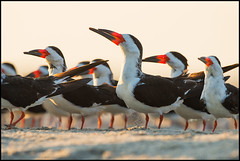
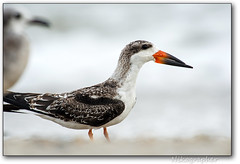
Black Skimmers in NY and NJ - 2016

Black Skimmers in NY and NJ 2016.


I enjoy watching and shooting the Black Skimmers.  They are usually a mix of adults and immature birds - when I see them both in New York and New Jersey.

They will let me get pretty close, but often will also seemingly fly off for no reason.  But usually it is a jogger, a person with a dog, or a predator flying by (like a peregrine, which I have seen buzz them at Cape May).

Some times when they take off they will fly around and fly off and land a half mile or more down the beach.  Other times they will land right near where they took off from.  For this reason I usually give it a few minutes and stay where I was shooting from without moving or getting up.  This has occasionally worked, and they have landed right back in front of me.

I find that cool.  And even cooler is when the birds approach me.  Sometimes this has been due to other people approaching them from another side/area, and it has also been when they have the water/surf on one side of them and me on the other.  When they run away from the surf and towards me, to a safer location, I find that to be a sign that I am there and not bothering them and they are comfortable with me shooting them.

It is also interesting to see them as they move this way and that way, and how often there will be an immature bird that must be tired and it is either sleeping and not moving or it is just slower to respond and follow the movements of the flock.

The really do behave like one bird, all in sync, when it comes to responding to perceived danger.  If they think there's something bad about to happen they will all fly off together in a moment.  Only once or twice have I seen them leave a bird behind, and that bird has always been injured or weak.  To survive they've got to be able to go with the flock when danger approaches...

 D500 w/ 600mm f/11 1/1600th
Nickerson Beach, NY
Black Skimmer on Approach

D810 600mm f/5.6 1/500th
Cape May, NJ
Sunrise Skimmer


 D500 w/ 600mm f/5.6 1/800th
 Cape May, NJ
Juv. Black Skimmer

Happy New Year.

-Jon


Sunday, December 25, 2016

EOY Thoughts on Seeing Differently Not Just Shooting Incrementally Better


My long time approach to making images has been to shoot, review, pick the best shots, and then try to do better the next time.

The next time I might have the past images in mind and I might try to reproduce the best images, with something new or with some element that was missing added this time.  Or maybe the next time I remove something that took away from the past images.

To me this is the standard approach.  And it is the kind of process that is needed to learn how to take or make better images in a large variety of circumstances and for a variety of subjects.

There are so many things to learn about gear and settings.  For example just coming up with when and if you want to shoot in manual mode or one of the auto-exposure modes takes time.  I shoot in a few different modes but mostly manual exposure with auto-ISO.  But there are still some times when manual ISO and manual exposure are better.  I like using auto-ISO when the light and conditions change a lot and dialing in some exposure compensation to adjust the exposure is easy to do.  Other times when the light is consistent, and the subjects are consistent going full manual can be better.  This allows for tighter control of the exposure and less variation, and I can try for more specific/artistic images.

Regarding exposure, picking shutter speeds for shooting can have a huge impact on the images and what is recorded, not just if the subjects are sharp enough or frozen given their speed and the size of the lens.  For this setting, there is the basic approach of calculating all the component parts of the setup and then trying to freeze the action.  Fast moving subjects - faster shutter speed.  Longer lens - faster shutter speeds. Hand holding the lens - faster shutter speeds. That's the basic math to be taken in to account.

But the more advanced thinking would be to not just respond to those and only try to freeze the action, to make simply a sharp image with a frozen subject.  Years ago I remember seeing this panda photo shot my Nick Nichols and thinking that I was unaware of so much that goes in to a good image.  It was taken with a long lens, in what I would now consider challenging light and shot with a slow shutter speed.  This informs me now about how those early simple rules for photography are a good starting point but to make better images I need to keep pushing.

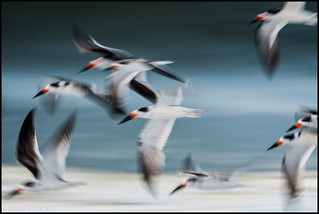
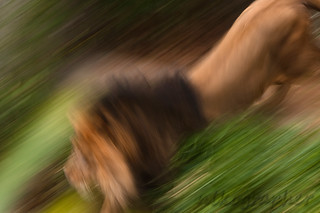
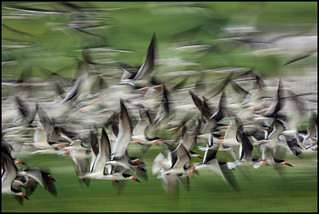
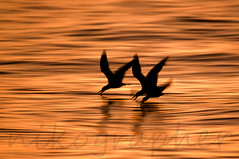
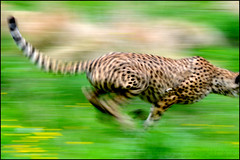
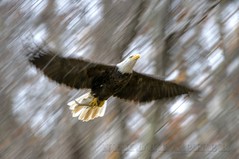
Here are some examples of images that use blur/slow shutter speed for positive effect:
Black Skimmers @ Cape May NJ///   Luke   ////Skimmer Blur
skimmin'Cheetah......................................!Cheetah on the moveSlowmotion


Realizing that the rules for sharp images are not rules to blindly live by has helped me grow.  Of the above images all are off a tripod with the intention of making the resulting image except for the last one of the eagle which was a 'happy accident'.

Capturing animals with some motion helps to bring them to life in an image that otherwise might be frozen and lack that feel.  Going back to that panda image - seeing some motion can really help bring more to a photo.

Capturing images that work with blur can be pretty difficult though.  Things that contribute to a motion blur image not working well are: too much blur, nothing being sharp, having to stop down the lens too much and seeing tons of sensor dust, the blur not going in the right direction due to imperfect panning technique, etc.

So what's the next technique, the next default thought process to get rid of or to question?  I have done a short project I called "going vertical" where I shot vertical composition for a while and that helped to break out of the way I was almost always shooting with the camera held in landscape/horizontal mode...  I even shot a vertical video...

IDK what's next.  Not shooting from eye-level is another approach to take.  It is easy to stand and shoot from that position.  Or to setup a tripod at eye-level and shoot from there.  But shooting from lower, or as low as possible really makes for a better/different perspective.

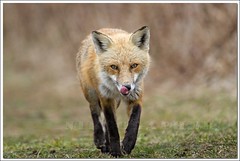
Black SkimmersThe Shadow Knows...Priceless - Red Fox @ Bombay Hook Refuge, DE

Another norm or standard that I've noticed was worth reconsidering is that of hoping for 'good weather'.  I now consider good photography weather usually anything other than clear blue skies or overcast and rainy.  As a result I like some overcast, or some clouds, or some rain and storms, or cold weather and things freezing or hot weather and animals that might be reacting to the weather...  This summer I specifically went to shoot osprey on 2 of the hottest days in order to see the birds hot.  It is harder to shoot on these types of days, be it hot or cold.  It takes preparation, and the right approach to pull it off successfully.  One of my go to things to help in all kinds of weather or times of year is to keep a case of bottled water in my trunk.  Being thirsty or dehydrated is easy to let happen.  But it is one of the simplest things to control when shooting and so many things aren't controllable.  It's just like always trying to be well fed, and to have ample snacks that are high in protein and good for me.  I often will do a day trip on a Saturday and drive 200-500 miles round-trip, where I get up a couple of hours before sunrise and get somewhere good, and then shoot all day and then drive home.  And then doing the same or similar the next day, on a weekend when most people might be resting, sleeping in and recovering from a hard week of work - to do it my way takes planning and execution.And being more prepared allows for something to not go my way, and not really be that bad or wreck a day of shooting.

So what's the next thing to mix it up and bring my photography to a new place?

I'm going to start 2017 by going West to a place I've never been, to shoot animals and landscapes I've never seen or shot.  I'm trying new things.

With the change in the year, I want to... think like I did at Kenilworth Aquatic Gardens when I went a half dozen times this summer.  I went, and went, and got the images I had defaulted to, and then I started to explore more and try for different images and I think I captured my best images of the Lotus Flowers.  I've posted a few myself, and shared many more with Tara Brach to use with her talks and meditation posts.

Lotus petal

A photo posted by Jon (@the_real_nikographer) on


I wonder what it would take to quickly see the default program running, the program that tries to get me to make the same images again, to see the way I have seen before and repeat things.  I wonder if there are ways to do less pattern matching and finding less comfort in the old, and seeing new and fresh, quickly or quicker...

I'm going to try new experiences, new locations, new approaches when I can, and I'm going to try to advance my photography and not just make 'sharper images' but make new and different images.

Happy New Year.
-Jon