Showing posts with label birds. Show all posts

Tuesday, August 29, 2017

A few recent Nickerson photos - summer 2017


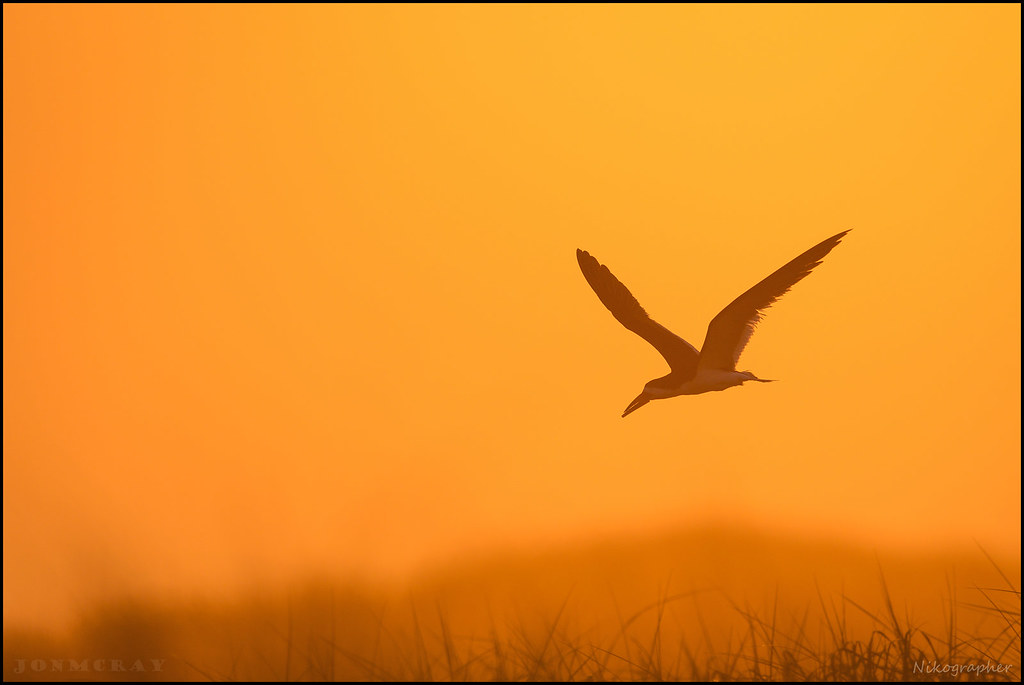
 The morning of the big eclipse I was at Nickerson and shot some skimmers and terns...

 Black Skimmer / Partial Eclipse

Sunrise Skimmer

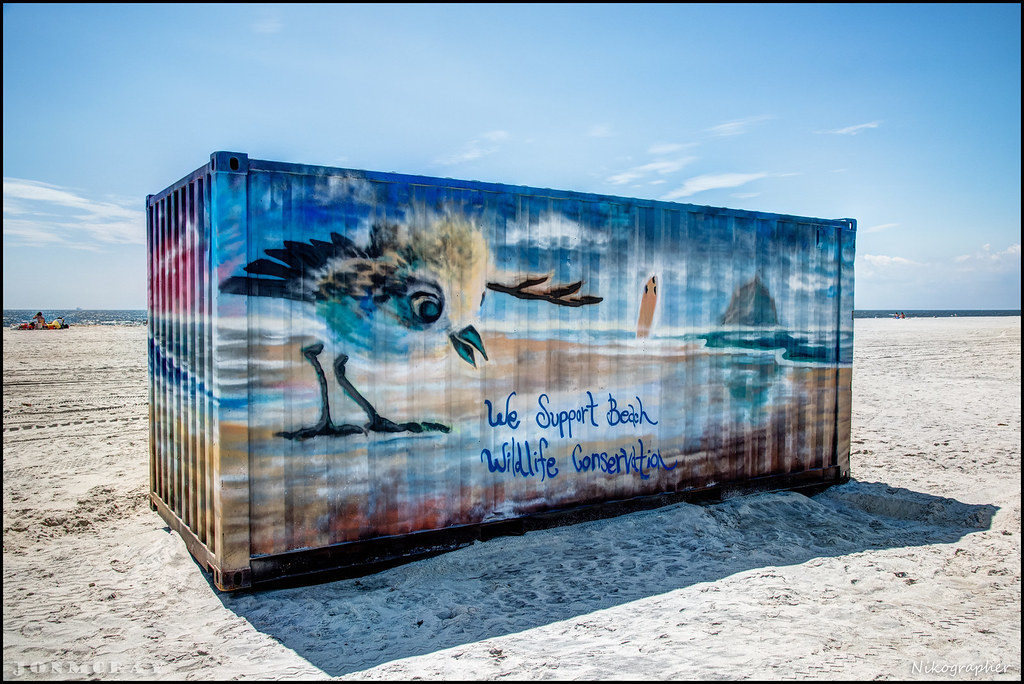
There was a shipping container on the beach, I assume it is used for storing Life Guard and beach maintenance supplies, but IDK...

Support Beach Wildlife Conservation

The paintings on it were pretty cool, I had to shoot them.

-Jon


Wednesday, June 7, 2017

Saturday, March 25, 2017

Going Old School - Osprey Drawings

When I was a kid, I used to like to draw.  I would draw cars, trees, boats, whatever.

Fast forward and now I like to take photos.  A ton of photos.  I usually take more than 100,000 photos a year.  A typical day could be 500-2000 images depending on how many places and cool things and action I encounter.

A month or so ago I bought a couple of sketch books and some pencils, erasers, etc.

Thursday I sat down with a pad and pencil and stared at it for a while.  Then I drew a box with a vertical line through it.  And I scratched my head so to speak...  What is that and why did I draw it?  I didn't know.  I still don't know, but it was a starting point.  I figured out that was NOT what I wanted to draw.  Usually my doodles are boxes, three dimensional distractions that are a waste of time but accomplish the goal.

Then from somewhere the idea of drawing a bird came to me.  I decided to try to draw an osprey, and drew about 8 that first night, each roughly a quarter of the page I had to work with. Here are 3 from the first night.


Then on the second night I used most of a page and drew this single portrait.  It's got some light and shadow...


Tonight (3/25/2017) I drew another osprey portrait but I didn't like the way it came out.  It was too dark and there some issues with the proportions being a little bit askew.

So I drew a second image and here's what I came up with, it is from an image I took today of an osprey eating a fish.  All these drawings are based on photographs I took at some point.  I put the image up on my iPad and then drew...


Tonight's second drawing (above) is the first that has the tail and the repeating patterns in the feathers, and the first with talons.  I drew it quickly and probably because I had done another image and given up on it, I was fast to call it done.  Looking at it more I could work on the eye more and the left leg might need some adjusting.  But part of this exercise is to go quick and make drawings and learn and move on.

I'm still playing with a few modes of doing the drawings.  2 days ago I started with the eyes and then added around that slowly.  Today I tried starting with the tree branch and then added the eye and then more of an outline of the bird.  In the future I want to try to do more of an outline of the entire bird/subject and then as I go fill in the details.  That should help me get the scale and proportions better.  But I also know from some past drawings that starting with small details and adding slowly to that can have a surprisingly good result because it is details added to details and the scale is considered for each small area vs. trying to get the scale correct all up front...

Hope you like the drawings, I had fun making them and plan to make more.

-Jon

Tuesday, March 14, 2017

2017 Osprey


When the osprey leave at the end of the summer I always anticipate their return 6 months later.  Usually that means early March, some osprey are back and I look forward to seeing my first ones of the year.

First osprey (1/2 of pair) of the year, from March 2017:
 Feasting Osprey


Possibly my 2 favorite osprey photos of 2016, from out at St. Michaels on the Maryland Eastern Shore.

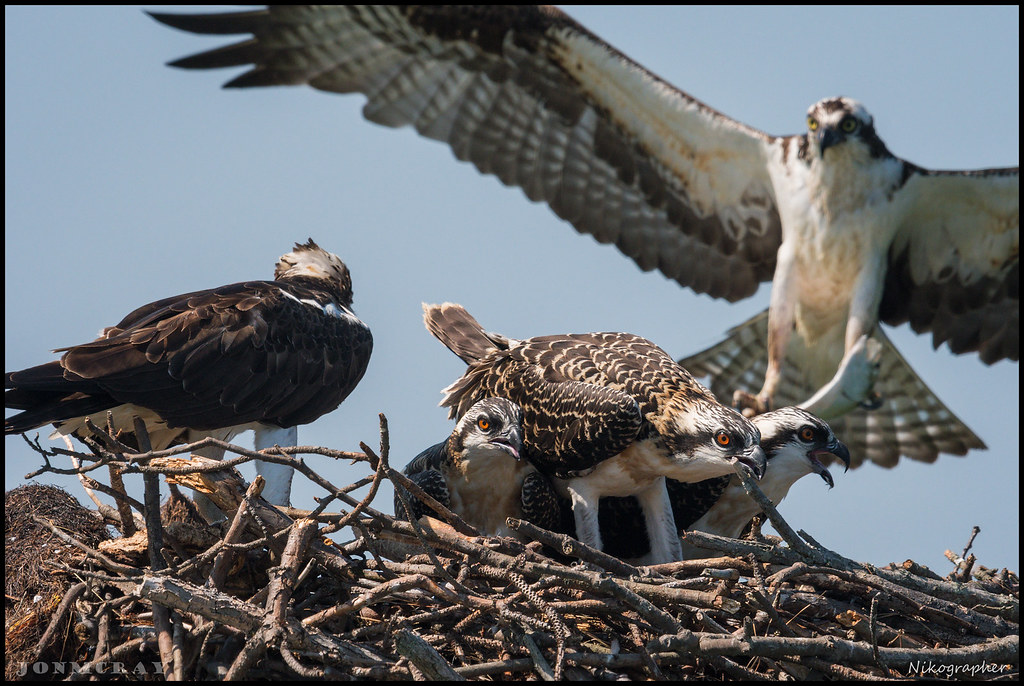
Male delivering a fish to a full nest:

July Osprey [1]


I don't previsualize photos very often, but this is one I planned for and hoped to capture.   The only thing I went to shoot on this and one other day were 2 specific osprey nests, which each had 3 chicks.

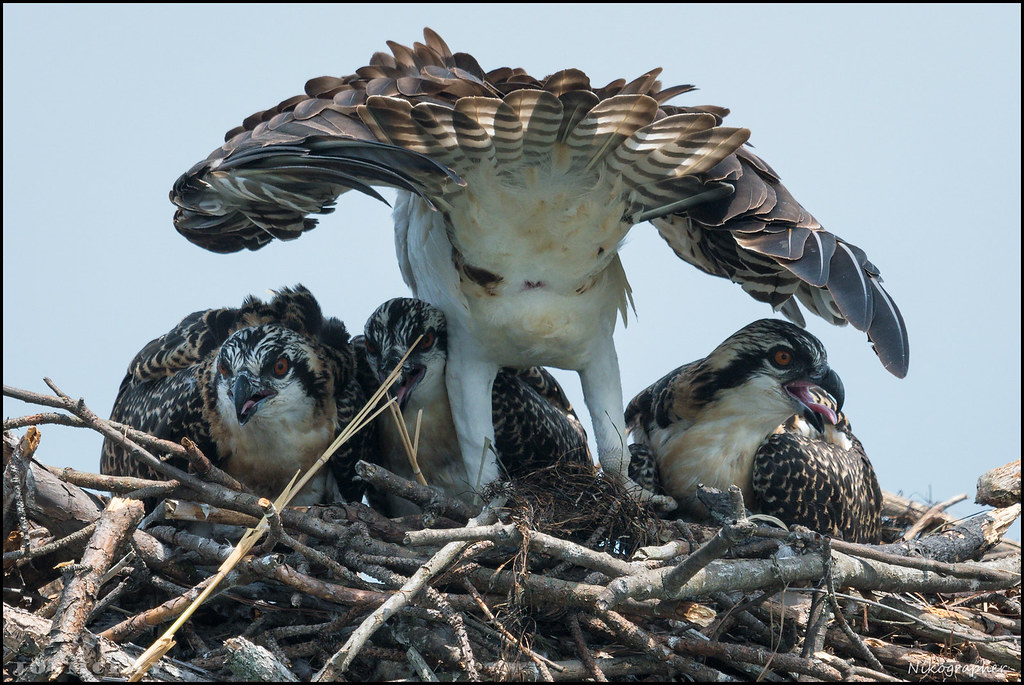
Female shading her 3 chicks on a near 100 degree day:

Happy New Year

-Jon

Sunday, January 22, 2017

2. Lower Wood, Ashwellthorpe

The Sun’s rays scattered by ice covered glass and grass turned into cake 
frosting; white, hard and crunchy under foot, it was a frosty winter’s morning in Norfolk. Parking at the medieval church in the village, birds could be heard calling from the suburban trees, surrounding fields and woodland. The short walk to the reserve was pleasant, a small distance along the road, then a public footpath along the perimeter of a field. The mixture of open landscape and woodland was a contrast that seemed popular with local birds of prey. A pair of buzzards took flight, greeting us upon entering the woodland over a small bridge. No sooner had we entered the woodland, and we were surrounded by smaller woodland birds calling and scattering, as well as a few chattering grey squirrels and a roe deer, before it caught sight of us. The tiny goldcrest imperceptibly moving from twig to twig and a treecreeper, somewhat more confiding, winding its way up the bark of trees nearby. 


Following the NWT arrows took us around the edge of this small reserve, with robins, blue- and great tits traversing the walkways ahead of us. Great spotted woodpeckers could be heard calling, but did not make themselves known by sight. A kestrel silently glided, carving the skyscape with long tail and arrow like wings, landing gracefully in the bare canopy. The coppiced trees provide ample cover for small birds with their almost impenetrable vertical swords of thin branches, closely packed. Larger trees twisted their gnarled trunks skyward, their asymmetry pleasing to the eye. Every tree, it seemed, filled with the calls and songs of woodland birds. As we completed the trail, a treecreeper was again at the entrance to bid us farewell.


Tuesday, December 20, 2016

July Osprey - 2016

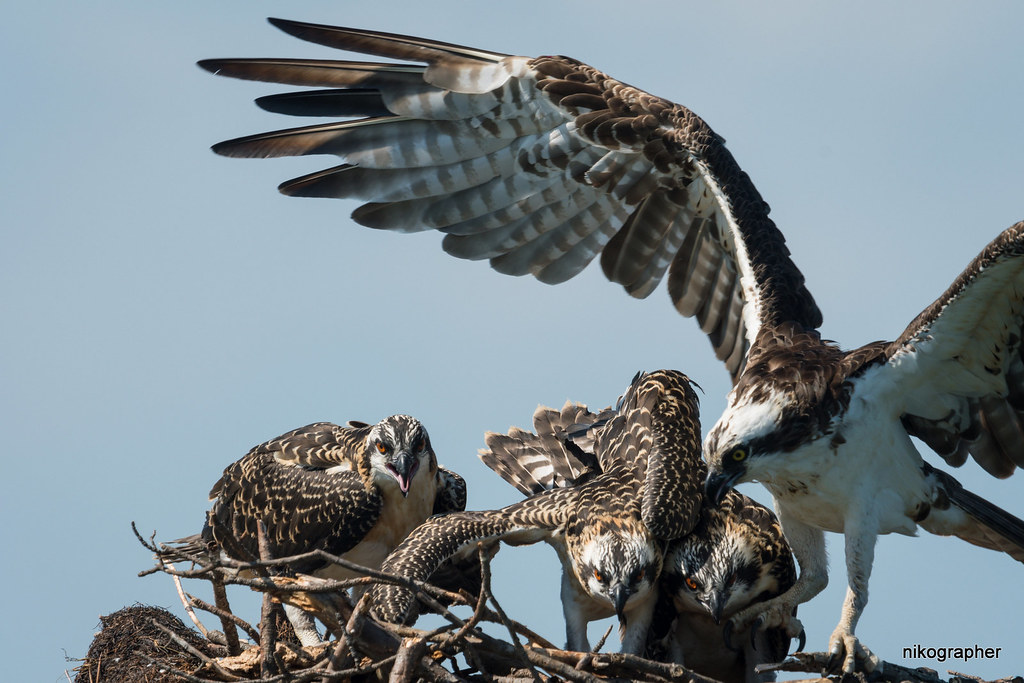
July is a great time for photographing Osprey in Maryland.  The chicks are getting big, and still in the nests, not yet fledged.  They are also eating a ton of fish so the adults need to be active to keep up with the demand for food.

In years past I have let other things grab my time and attention and I have missed out on shooting the osprey chicks.

But this year I took a day off of work, and I also took a weekend day and went to 2 specific nests near St. Michaels Maryland to shoot the birds.  There are so many nests in Maryland, but I liked these two because they are near but not too near to land, and they each had 3 chicks this year.

At the first nest I watched as one particular bird worked out, flapping away, gaining wing strength.

July Osprey [3]

What really caught my eye was how the adult was perched slightly higher than the chicks, and was surveying the area but also keeping a close eye on the chicks too.

July Osprey [2]

The other nest I shot at had the 3 chicks, and they spent more time being fed.  The male osprey was nearby and delivered 3 fish within about an hour while I was there for about 3 hours.  It was super hot, above 90/95 degrees.

While shooting from a nearby marina I drank 4 bottles of water to just keep up with the heat and sweat.

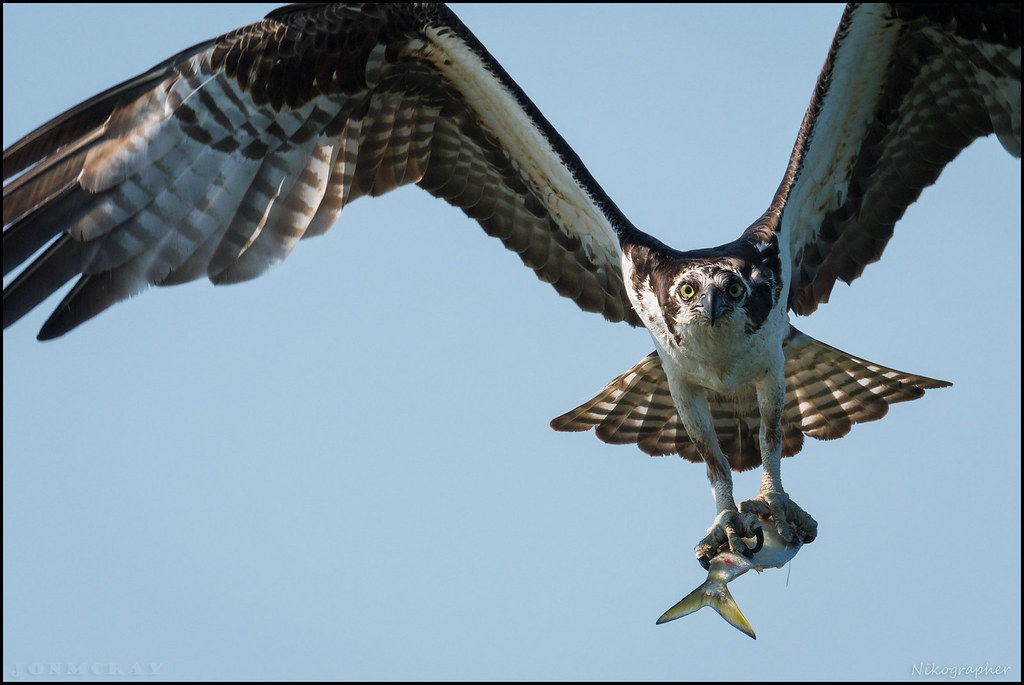
The above photos are new posts to flickr.  The below images I have shared already, here's the male at the second nest checking me out while carrying a fish, and then coming in for a landing at the nest.

MD Osprey

Osprey Family @ St. Michaels, Maryland

I really like how crowded the nest seemed and how they were all huddled together so closely.  They were also very eager to eat, and the female (adult) went right for the fish and then repositioned herself to feed the chicks.  The male was more tentative.

It is not that often that I have seen and photographed chicks and both adults in a nest.  Usually the male will stay away or fly away quickly.  This male was similarly edgy but delivered 3 fish, and stayed in the nest longer than I expected.

MD Osprey 

Part of the reason could be the distance of the nest from the shore.  It was not that close - I used a 600mm and crop body (D500) to shoot them, and with a 1.4 teleconverter for some images.  In addition, when the male came by and seemed to do a couple fly-bys checking out the nest and me, but not landing, I backed up slightly, until he landed on the nest.  At one point I also used a cheap wireless camera trigger - where I set up the camera on the nest, turned off auto-focus, and then walked away to see if the birds' behavior would change.

During this time the male caught the fish and then would land on a nearby channel marker and eat some of the fish and wait.  The male, and female actually while the male was hunting, took to the air to ward off other osprey that intruded on their territory.

Each day was about a 4 hour drive round trip, and probably around 4-6 hours shooting. 

 The osprey should be coming back in two and a half to three months.  It will be fun to see them again.

-Jon

Saturday, December 17, 2016

Catching up in late 2016 - 3 photos from 3 locations


I was posting regularly and then well I wasn't.  I did it for a bit, but then fell back in to my old ways and got busy doing other things (but still shooting mostly).

As 2016 is winding down, I was thinking about using December to catch up and post a new photo a day, but that didn't happen.

So today I just posted 3 images, each from a different day and locations.

(In chronological order)

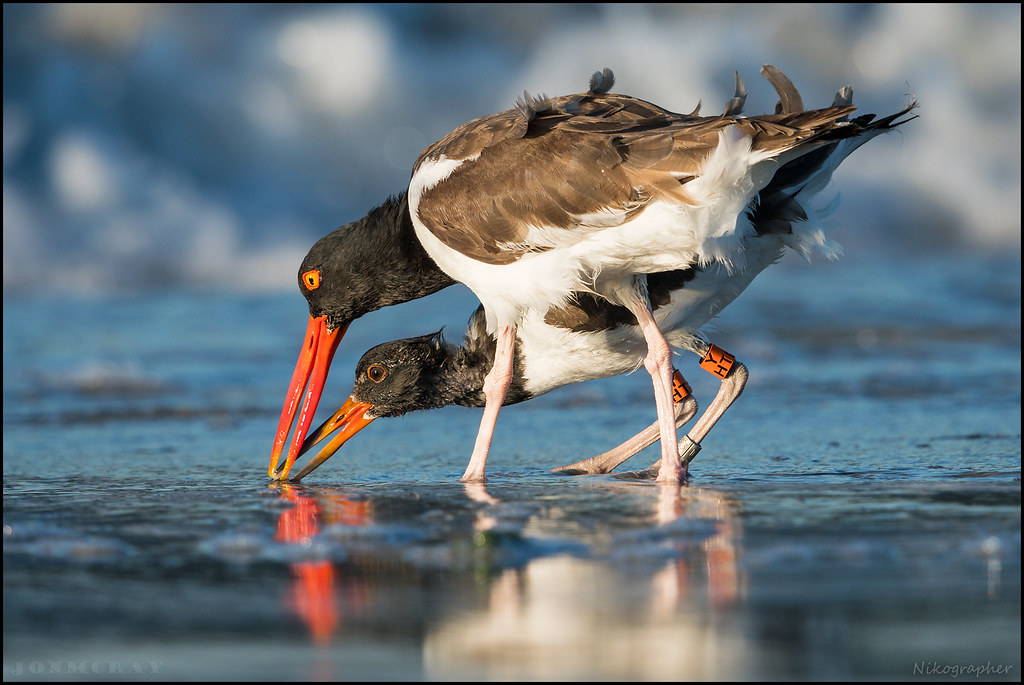
The first images is of some oystercatchers, an adult and chick, feeding in New York, in late August.  I grew up just down the beach, literally, from this spot where a bunch of different birds nest (common terns, black skimmers, oystercatchers, plovers, etc).

The oystercatchers can be a little hard to shoot if they get weary and react to being watched.  This day I tried to notice when they were watching me and then looked away and didn't eyeball them.  It mostly worked and I shot them from a fairly close distance as they went around hunting and feeding their chicks.  There were a handful of adults and chicks.

Feeding Time


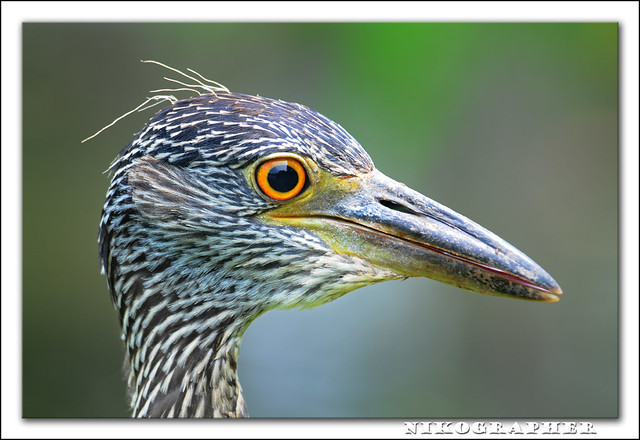
Next I shared an image of a Green Heron from Kenilworth Aquatic Gardens in Washington DC.

This year I went as many times as I had been in all previous years combined. Earlier in the year I photographed the lotus flowers a bunch, experimenting and doing some macro stuff in the last few visits.  By September when I got the heron the flowers were past, except for a few lotus, and for some water lilies in the back ponds.  Most of the busy summer traffic is over and I saw just a few other people there this morning.  Everyone comes for the lotus - so by September it is much more peaceful and low key.  And even if your thing is flowers there were enough water lilies to make it good.

Green Day

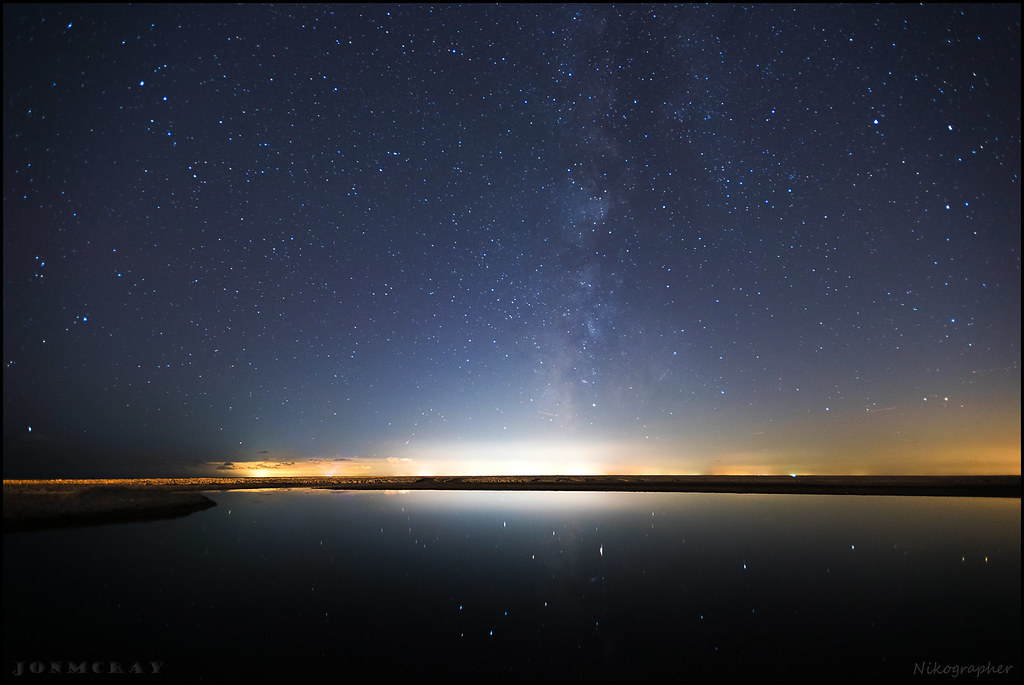
Finally from later in September, I shot some stars at Cape May along the beach.

I've only experimented with star photography a little bit, I think all this year.  It can be a challenge.  Getting good focus is hard because it is night out and the stars are small and far away - I used manual focus on nearby lights and tried to chimp and adjust but I need to work on the night focus techniques...  With the cold nights, it can be hard to keep the lens from fogging up (but I plan to use hand-warmers to keep the lens warmer than the ambient air temp and some special lens coating/spray to prevent fogging next time).  I also wonder if shooting from sand (ie not solid ground) contributed to softer images.

Dream Big

2016 has been an amazing year, I've seen and done a lot.  I've changed a lot of things I needed to change (in 2015 and 2016).  I've been meditating for a little more than a year, and chalk up a lot of the movement in my life to that slowing down practice.

-Jon

Monday, November 28, 2016

The world we see is what we think it is, not what it actually is...

So much of our reality is self-invented, self-limited.
We see what we want to see.
We see what we have seen before.
We see what we expect.

We see what we allow our selves to see.

We are blind to what we do not expect.
We are blind to what we do not see with our eyes closed.

Reality is a fungible thing.  We don't think it is, but it is.  We bring so much to the table when it comes to enabling a reality to be experienced.  We bring so much that it doesn't seem right.  It should be an objective thing, something that just is.

I recently heard the saying "I'd rather be the person that bought the Bridge, than the person that sold the Bridge".  And I would rather have bought the bridge, than been the person that knowingly tricked and took advantage of another...

So what about photography?

As a photographer I see what I see and then make a choice to capture it.  But how can I capture what I don't see?

One way to overcome this might be to play.  Playing allows me to try things, to experiment, and to not have an expectation or result in mind.  An easy example of this is to play with slow shutter speeds and see what happens.  The pleasing results can be few and far between, but then there's that one that works.  (Kind of like most of my experiences on the golf course - the rare well struck ball that makes the day fun.)

Another way to overcome the expectations of experience and past sight is to put the camera up to my eye and see what I actually see.  This is different than looking without the camera, because the camera restricts vision, frames it in a little box and focusing the mind on just what is there.

And another way is to slow down, and sit, observe and stop looking for a pattern match.  This can be when I start to see past everything I've brought to the day.

--
I was in Florida this year (2016), my 5th year there to drive around and see nature, photograph birds and landscapes, etc.

While there I made it to Fort De Soto and looked for the GHO nest from the year before but I didn't see it and was disappointed.  So I did what I have learned to do when this happens and I found a local (park guy) and asked him some questions.  I learned that the nest I was looking for failed, as did another nest in the park - but there was a nest by the fort just up the road.

I have learned to value locals and their knowledge, and to not be afraid to get some advice.  When I go to a new National Wildlife Refuge for example, I will stop by the visitor's center and talk to them and try to learn from them. By contrast I also do not do a ton of prep/research when going somewhere new and try to have an open/fresh and unplanned approach.  It doesn't always work for the best results (images), but it removes stress and expectations and in that regard I am good with it.

Once I knew where there were owls I headed over there and quickly found the tree with the nest and 2 chicks.  It was in a grassy area just off of the parking lot and the tree itself was in a small area protect by some orange tape to instruct visitors to keep their distance.

Great Horned Owl Chick

I saw the chicks and took a few photographs.  Then I saw another photographer and we started talking a bit.  He said he had been there for a while and didn't see an adult around but he had looked this way and that way and was keeping his eyes opened.

By now I had just been here for maybe 5 minutes and he said he had been there for a couple hours.

What happened next is the reason for this post.

I could have taken his longer observation as fact, and shot the chicks and nest some more and then moved on.  But instead I used my own history with nests and birds and I had a hunch that the female/adult was nearby and within eye sight of the nest, watching over it.

A few years ago I watched another Great Horned Owl nest a few times, and learned that the female would hide in almost plain sight, but high up and blending in to the canopy.  This makes good sense to me - laying eggs and raising chicks is a huge investment in time and effort, and the adult is not likely to be off hunting or sleeping or whatever away from that investment if they have a choice.

With my own perspective, and not the other guy's perspective, I found the female perched in a tree, a tree INSIDE the taped off area, within just a few minutes.  From the perspective below, you can actually see the bird in this wide angle shot pretty clearly outlined.


She was there, clearly resting and watching the nest, from a very close vantage point.  She was hidden, but not that hidden.  One thing I remember the other guy saying after I spotted her was he didn't think she'd perch in a palm tree so he didn't really look there much.
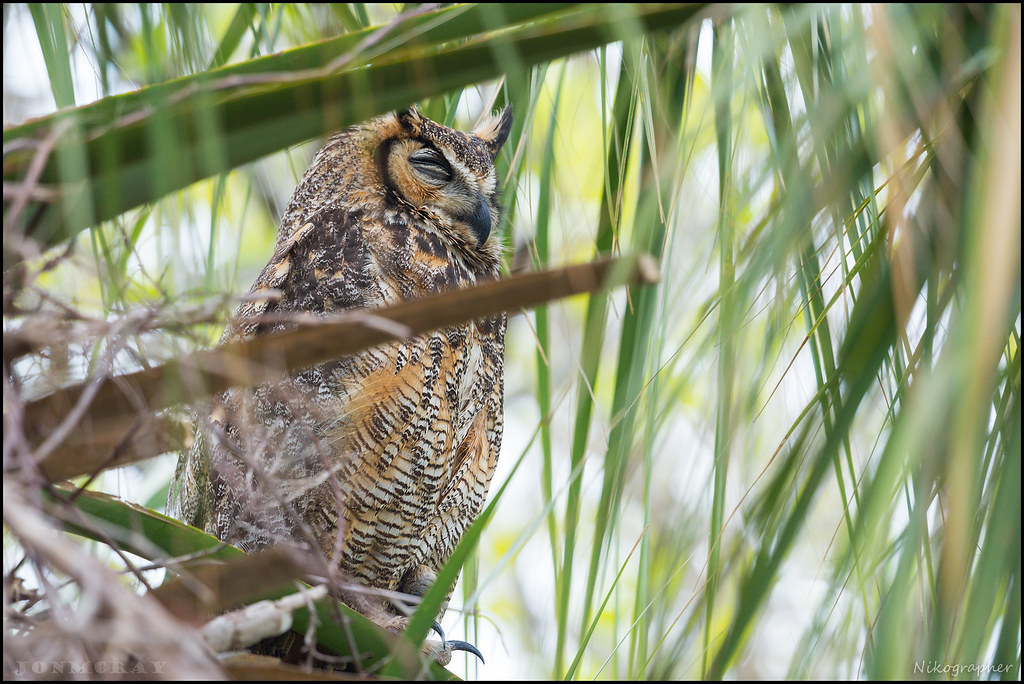
Great Horned Owl - Fort De Soto Florida

Reality is more than just what you see.  Look harder.

Saturday, October 8, 2016

Kenilworth Aquatic Gardens Summer 2016

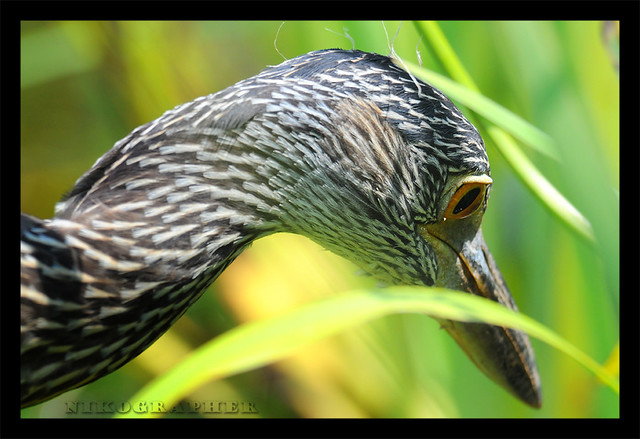
Over the last 8 years I've been to Kenilworth Aquatic Gardens a bunch of times, mostly looking for the Yellow Crowned Night Herons. But also other birds and the great Lotus flowers and water lilies.

This year there weren't any YCNH's that I spotted, so I photographed the Lotus a *lot*.

Sometimes the petals would fall off quickly, in a sort of chain reaction once the first one broke free. I'd never seen that before, it was cool.

Lotus Bloom

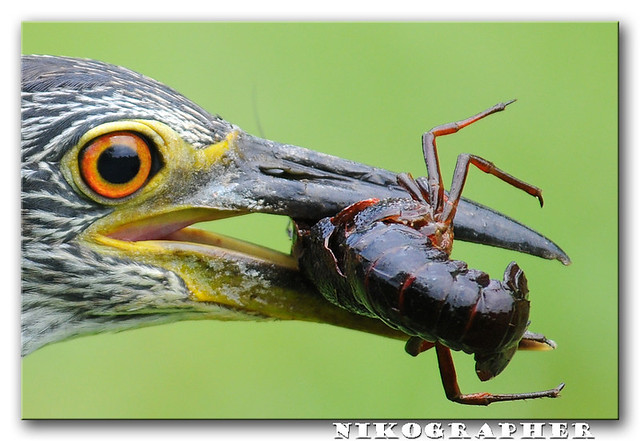
The YCNH's were great in 2008. I went multiple times and got some close ups and some feeding photos...

Yellow Crowned Night Heron

JYCNH Hunting

You Can See The Crunch

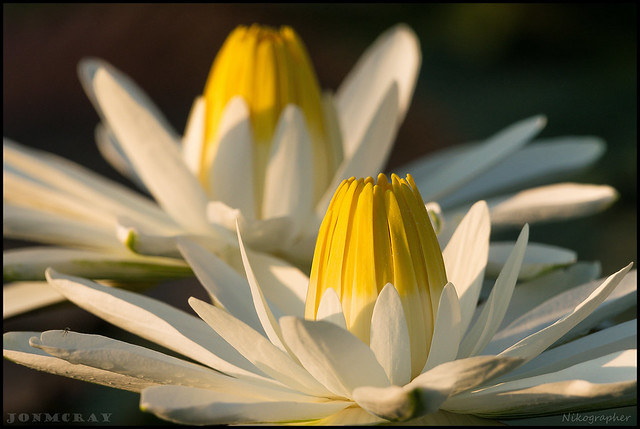
The second to last time I went this year I shot the water lilies in the back, and the light was pretty good. I used a 600mm lens, which I would normally use for birds, and I shot the flowers...

Water Lilies @ KAG

Just prior to this visit I had gone to Kenilworth Aquatic Gardens I think 5 times, and the first few times I took a normal approach and shot the flowers with a long lens, and had hoped to see birds, but still shot the flowers. The images I got were "normal" and looked ok. I was happy with them at the time. But they were like many other images I've taken and seen others take. This one with the Red-Winged Black Bird was a highlight. The birds were in the flowers and I could shoot them for just a few minutes before they flew off.


So this year on visits 4 and 5, I brought some macro gear and shot much closer images of the flowers and got much different and I think better results.


As I reflect on the half a dozen-ish visit I've made to KAG before this year, and then the 6 or 7 visits I made this year I noticed how it took a few visits to shoot through the shots and approach I had in my head already. It took that long to then be able to try to think differently, to see the gardens and flowers differently and to get different images.

A photo posted by Jon (@the_real_nikographer) on

On the last few visits I still brought a long lens (600mm) but I also brought a 70-200mm f/2.8 and a 24-120mm f/4 lens, along with the Canon 500D closeup filter for a 77mm lens ring. By using that filter I was able to turn both lenses in to very close focusing lenses that gave drastically different shooting distances and super narrow depth of field.

I'm happy with the results I got this year. It took a bunch of visits to get lucky with the RWBB and then to start to see and shoot the flowers in a new way. In the future I guess I hope to be able to push past what I had planned and the way I was seeing things initially, and start to see in a fresher/different way like I did on visits 4 and 5 with the macro shots.

I've been meditating and practicing mindfulness this year and last year, and as I read what I just wrote above, I think that is a result of this new approach to life. It's all too easy to have a plan, work towards a plan, and then either execute on the plan and be happy, or not execute on the plan and be disappointed. But with a fresh approach and fewer expectations, and a more flexible nature new and unexpected things can happen.

-Jon
Nikographer.com / Jon

Saturday, October 1, 2016

Cape May NJ 2016 - Juv. Osprey Fishing

During the Fall I love to go to Cape May New Jersey. The raptor/bird migration is great. My friend Wayne turned me on to the location a while back, and I've gone every year since.

This year I have been once so far on September 24-25 (2016). It was a little early for big numbers of hawks, and the weather was not great for it either.

The best setup for hawk migration is when a cold front moves through, pushing birds east, and the prevailing winds are out of the Northwest. This pattern pushes birds towards the east coast and the way Cape May and the Delaware Bay are the birds run out of land to fly over, since there's water everywhere else and they tend to stop over on the cape.

But it's Fall and it's Cape May so not great here still has the potential to be good.

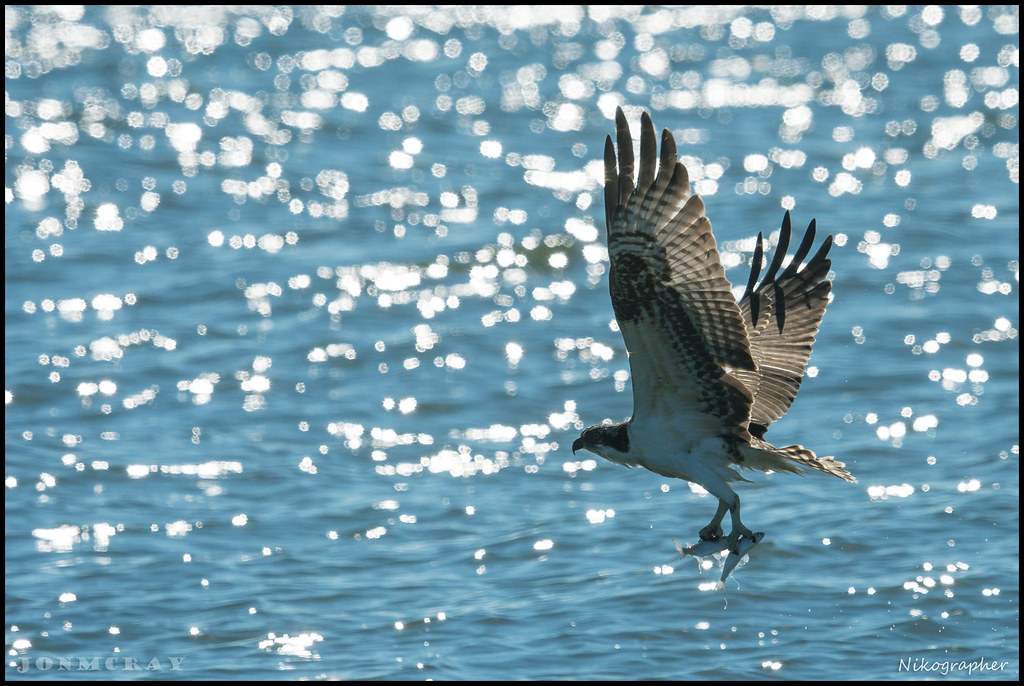
On this morning there were a few young osprey flying around over The Meadows and along the shore, over the Atlantic Ocean just at the edge of the beach.

The young osprey aren't very skilled at hunting yet and it takes them a lot of effort to catch fish. Here the osprey has caught 2 small fish, after trying numerous times to get something. I also saw dolphins in this same area and they were hunting as well. I probably saw more than a dozen of the dolphins over the course of a couple of hours.

Juv. Osprey Hunting @ Cape May NJ

Juv. Osprey Hunting @ Cape May NJ

(updated - 10/11/2016 with another image) Juv. Osprey @ Cape May NJ

The ideal time to see hawks migrating is when the weather is right, and during the first couple of weeks in October based on my experience...

To see more of my Cape May photos click on this image to see my flickr set.

Sharpie @ CMBO Banding Demo

-Jon Nikographer.com / Jon

Wednesday, September 28, 2016

Ready for Fall and Ready for Good Luck

For a bunch of years I have made it to Shenandoah National Park during the fall foliage season.  I tend to go and have had some of my best luck on October 20th.

In general I get there an hour before sunrise, and then drive south along Skyland Drive, and check various overlooks and then shoot sunrise from one of them.  As the day progresses I will drive further south and continue to check out the overlooks and shoot photos from them.

I've not explored the trails at SNP at all really, just a tiny bit of walking here and there but nothing that would be considered a hike.  I know I am missing out on a lot of great areas and things to see, but that's not how I have shot there and I don't know the area well enough to go looking without doing with the potential for nothing coming of it if it isn't a good spot to explore or to shoot from.  In the future I may change that, but for now not so much.


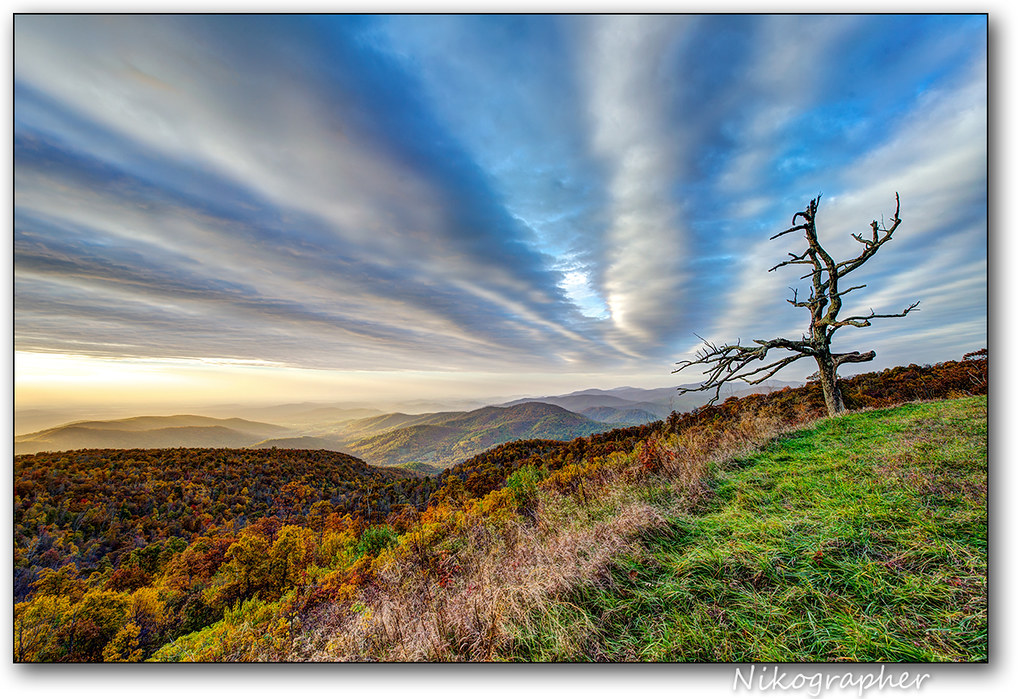
But there are great views from the overlooks.  Here is one from 2012 that I like a bunch.  The sky was great and the foliage was pretty good too.
Oct 20 2012
Day Break

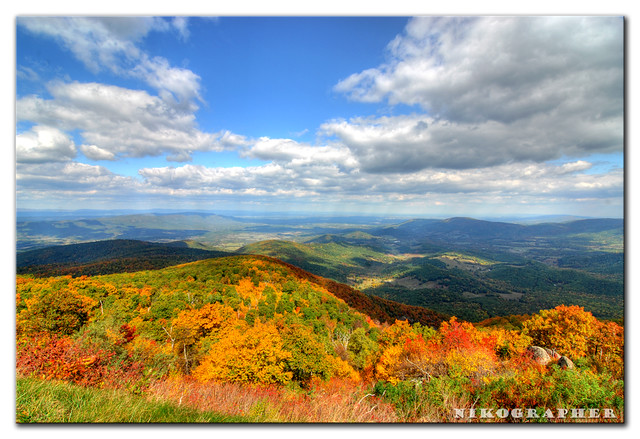
This is from 2007, my first visit to SNP. 
Oct 20 2007
Fall's Gold

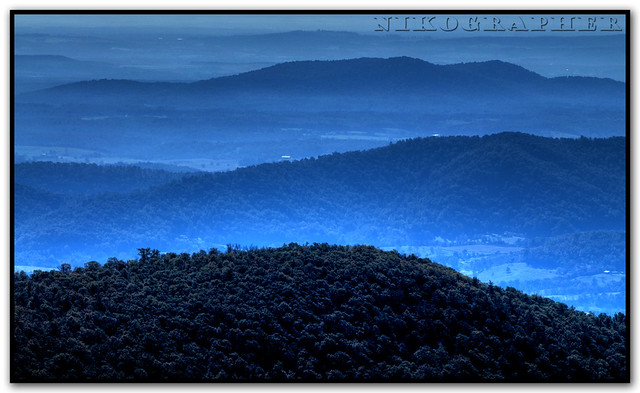
This photo is from the second year I've been to SNP, and I like this since it has the "blue ridge mountains" in it!  
Oct 26 2008 
BLUE

Finally, in 2012 I got really lucky! 

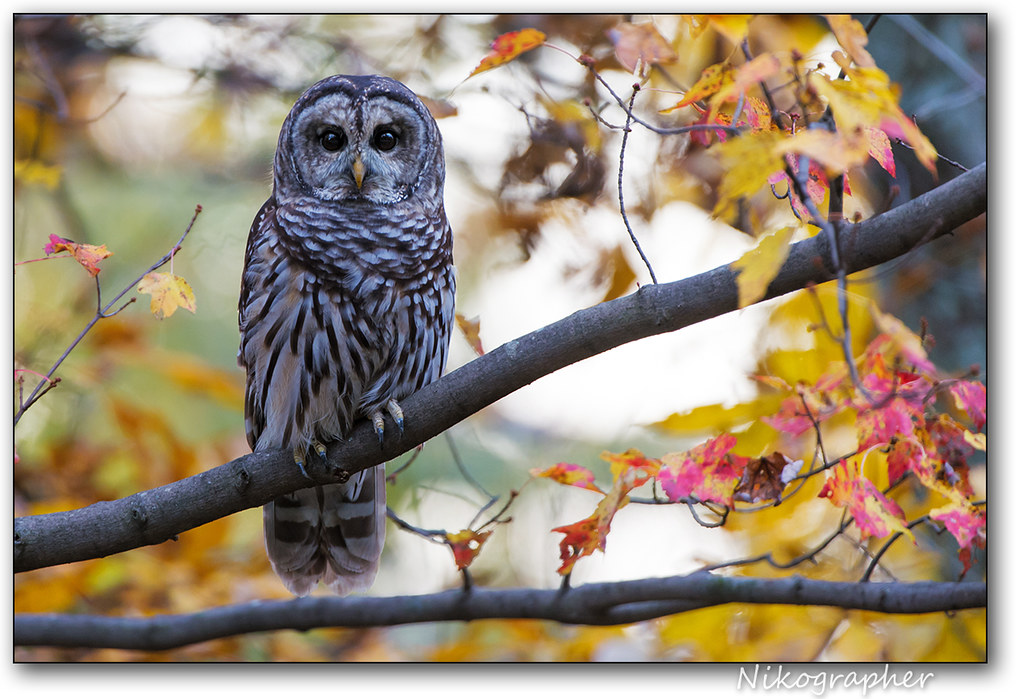
I was driving along Skyline Drive and had my 200-400mm lens on the front seat next to me.  As I drove down the road, I had the though that I'd like to find a little foliage detail and shoot it with the longer lens.  So I slowed down, and was looking for interesting and colorful patches of leaves.  After just a few minutes of this mindset, I saw directly out my driver side window, this Barred Owl!  It was sitting along the side of the road and wow.  I was so lucky to be going slowly, to have the window down, and to be planning to shoot with a long lens.  Normally I would have a couple of wide angle lenses at the ready to capture a landscape scene...  But I was ready and I was very lucky.

The owl stayed there for just a few moments, and then flew away.  My shutter speed was only 1/250th, but it worked even though the car was running, I was hand holding and there was an unexpected owl there.

Oct 20 2012
Barred Owl @ Shenandoah National Park, VA

I'm planning another visit next month and I hope to get lucky and I hope to make some nice images.
Nikographer.com / Jon

Thursday, July 30, 2015

A bird buffet

I couldn't think of a collective noun for all of the different species of bird that visited our feeders this morning, nor could I believe my eyes. I don't think we have ever had this many birds on our feeders at one time, so I had to take a video to prove to myself later how many there actually were! It is too large to upload to blogger, so you can see it on youtube here.


Whilst we were watching this volery of long tailed, blue, great and coal tits and greenfinches, I noticed another less familiar bird hiding among the honeysuckle berries. Dunnock-like in shape, but with a white nape, I didn't get a good look at first. Eventually it did return and turned out to be a beautiful little Whitethroat.


Monday, July 20, 2015

Project Wild Thing: Day 2 & 3

Day 2: Birds and Badgers

My colleague and I arrived at work at 8:00 am. She is licensed to ring birds, so to give our students an experience of bird ringing, we set up a mist net around a bird feeding station. We also checked our camera trap (nothing) and our two mammal tunnels. The weather overnight had been wet and windy, so we weren't expecting much. To our surprise though, there had been a small bird through both tunnels although we're not sure what!

We had also arranged for Dr Jen Smart (of Springwatch fame) to speak to us about her work on badgers. Follow the link to find out more about her work. She brought in a GPS collar for the pupils to look at and explained all about the behaviour or the Minsmere badgers.

During her talk, a sparrow was caught in the mist net. So we paused and brought it in to ring, weigh and record. The pupils were fascinated by being so up close to a wild bird, especially when they got to hold and release her. We caught another female sparrow later in the afternoon.


Our next mission was to look at enticing and making homes for birds. Our students, with the exception of one vegetarian, took up the gauntlet and got messy using lard, dried fruits and sunflower seeds to make 'fat balls' to hang up around the school. A very messy but hopefully worthwhile endeavor. Our technology department were also kind enough to cut us out some bird box templates, so we thoroughly exhausted ourselves trying to hammer them together and paint them. Some have opted to take theirs home to put up in their gardens, others have left them for us to put up around the school.


For the last part of the afternoon, we went on a bird walk around the field to see what we could spot, and see if we could put into practice the bird calls we had been trying to memorize throughout the day. We have five oystercatchers on site, some of which allow us to get quite close before flying and alarming, so we managed a few pictures of them.


Day 3: Pensthorpe

Today, we took our pupils to one of my favourite places. We had a lovely day out. We started off in the Wader Aviary, identifying red shank, stilt, bearded tits, avocets... then went to feed the wildfowl collection. One of our pupils went from being scared of the birds to wanting to feed them really quite quickly. They enjoyed watching the birds rushing for the food and diving for it under the water.


At 11:00 am, we had booked to meet Tulu the barn owl. We got really up close to this beautiful bird and their knowledgeable park warden explained the different adaptations of the barn owl (eyes, ears, beak, talons), quizzed our pupils and answered their questions. We even each got a turn to stroke her. All were amazed by how silky soft her feathers were and how calm she was with particular people.


After our amazing experience with the barn owl, we visited the conservation area. We looked at the red squirrels and all the different sorts of crane. Our pupils were particularly taken with the Northern bald ibis. There were also lots of young birds around these parts. The white-naped crane chick had finally hatched and there was a much larger but still young crane in another enclosure. Mallard ducklings and young moorhens were also to be seen around the park. These certainly had the cute factor for our pupils!


After lunch, we went on the long trail through the woods and along the river. I didn't notice at first, but the younger and faster eyes of some of our pupils did - there were froglets everywhere in the leaf litter either side of the path! We tried a bird hide, but there seemed to be an early afternoon lull in activity, so we only lasted five minutes before most of number were 'bored' and wanted to leave. We continued our walk and ended up at 'Wildrootz' where they could relax and have some fun before heading back to school. All in all, a successful day!