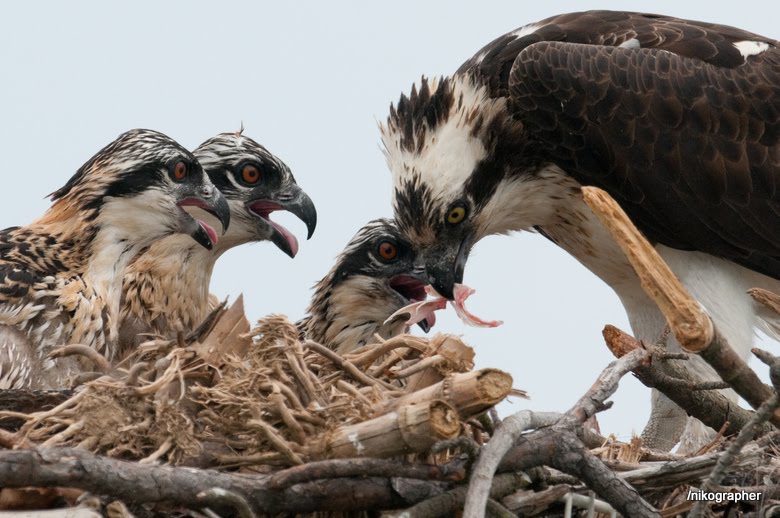
I haven't been to visit "my" nest in a couple weeks. Last I checked the 3 chicks were doing well.
(6/19/2011)
I visited tonight and was met with a sad sight. One of the 3 osprey died, and is still in the nest.
(6/30/2011)
The chick in the background was really bothered by the situation, just looking at its sibling that wouldn't move any more. And it bothered me too.
I couldn't tell what the cause was for sure until I got home and reviewed the images closely, but I had a suspicion. I thought maybe a hook from a snagged fishing line had managed to be eaten by the osprey. But it appears that the osprey chick got tangled in the line and died from that.
There wasn't much to do, but I reported it to someone that can hopefully get a visit from someone that can remove the dead bird.
And to be expected, mom was still mom, and yipped a couple times. And dad came by with a fish, circled a few times, and then delivered a fish. And then mom fed the (2) chicks.
I think to be a successful nature/wildlife photographer you have to be judgmental! What do I mean by that? Well here goes...
To make animal photos that are more than snapshots, more than an "oh look, click!" type of photo it takes skill in observation. It takes time to see and think like the subject. To make predictions and try to either put yourself in the right spot at the right time or to let something play out the way you would like.
In my recent shooting of the osprey nest here in Maryland I've noticed a few things, and tried a few things, and had pretty good luck.
read more... The first time I visited this nest, was a couple or more months ago when the female was on eggs, so no chicks yet. What I noticed was the nest was super close to land. Having seen a nest or two that was too close for the bird's comfort I was excited and a bit cautious. I decided to wait to come back. And by the time I came back again 2 of the 3 chicks were fledged.
When I got there a walked up near the nest, and got the usual yips from the chicks and more from the mom. After a minute she calmed down, and I also backed off a bit. After that and a little time it almost became hard to get a reaction from them. I didn't want to them to fly off the nest or anything, it was just odd that they didn't care so much, even if I was pretty close.
It was then that I knew they were used to people being in the area and while aware of it all, they could deal with it well. Later visits I'd get close, back off, other people would come by or a boat or a plane and the additional activity might make them fly.
Judging the circumstances and their behavior - on more than one occasion I backed away from the nest and sat down, or generally looked away did my thing to let them watch and come back to the nest, and not be bothered by my presence. This tactic worked.
If you've watch an osprey nest you are probably aware that the adults are big and can take care of themselves well, be it a crow or an eagle, or another osprey that is a threat. But they can also be skittish and fly away from the nest if bothered or not come back if a person is too close.
I've watched that series "In to the lions den" and I think a lot can be learned from it. The guys approach is to be super observant and to build awareness of animal behavior. Then to take that knowledge and try to build trust with the animals so you can come to a common ground where you just are there, and they don't get bothered by his presence. In the show he used this technique to go from roaring lions at 150 yards, to laying down on the ground unprotected at around 15 feet from the pride!
While I'm not him, and these aren't lions, observing osprey and trying to make all kinds of judgments as to their thoughts and your actions has led to some great chances at photographs.
This particular location is odd and great in that the birds are close and NOT bothered by people that much. They've become habituated to people being in the area. And the calmness of the adults has carried over to the chicks. This weekend the 3rd chick fledged (or had just done so the day before). Using past experience I'd say that birds which aren't comfortable - that can fly away - will fly away if bothered. This weekend the birds didn't fly away due to me being there at all I think. I even got as close as the shore would allow, and got the occasional stare but not much else.
Then came the male. I hadn't seen him all that much. In the week or so of observation I'd been wanting to see all 5 birds (2 adults and 3 chicks). When the male visited late in the day, he flew by and buzzed the nest and fly off. Having seen this same skittishness in the male from a different nest I watched last year, I backed off and waited and within a few minutes he came back and delivered a fish.
Last year when I saw this skittishness I tried to avoid taking shots after that first fly by on the nest. Holding off worked sometimes but he was still skittish. And this testing it out on my part was difficult at times because I wasn't the only photographer there. The other guys did try it too and it seemed to help but the birds were uneasy and with multiple people it is a hard thing to control and gain insight from. Imagine if that Lion guy was trying to get to be friends with a lion pride and was doing it while part of a group of 3 people!?@
This weekend when the male flew by I took the initial shots of him flying, backed off/away and he came back. Then he went and caught more fish and I repeated the same thing but moved off quicker and he came back quicker too.
The point of this is to be observant, be in the moment, watch for signs of discomfort in subjects and possible causes which you might control - like movement, distance from subject, noise you're making, etc. Animals will give signs of their comfort or lack there of, and often will do it before they are ready to fly away.
Watching nests can be pretty easy as a photographer, and pretty stressful on the birds if you get too close or don't watch for the signs and respond to them. It is a common things for birds to abandon eggs or even young chicks if they're bothered. When approached properly though getting to see the variety of behavior and interactions between adults and offspring can be very rewarding.
--
As a photographer I like to be thoughtful and question my own actions. I also like to watch others and then wonder to myself if I'd do it the same way or differently given the chance. To get close and get close photos takes more than a long lens. It takes time to observe and learn, and time to experiment and to try again and again.
This spring I spent more than a couple days hunting around for the new perfect spot to try to shoot osprey. I had two in mind and my fall back spot turned in to the better one. In a couple evenings and a couple afternoons I shot around 60GBs of stuff (osprey and a couple green herons). I'm going to try to go back and get more of the adults and especially the chicks fishing. I've seen 1 or 2 of the chicks hunting and been surprised how clumsy they are, but how well they do too.
Make plans! Summer will be wrapping up before you know it and Fall migration will be upon us. What will you do to see better things, take better photos and make this Fall your best? I'm going to visit some new spots, as well as some spots that were new to me last year.
A couple weeks ago I went to the Air Show at Andrews Air Force Base. This was my 5th year going, and I'm starting to get my fill of it all. The highlights of past years have been the F-15 which is awesome and so fast when they kick on the afterburners. The F-22 Raptor is amazing too. It can basically defy normal laws of physics, and hover, flip, flop, slide, go backwards, sort of crazy.
-click for more-
The part that has gotten pretty old this time is the crowds. My basic routine for the past few years is to be on one of the very first buses from Fedex field so I can get a front row spot near the middle. Doing it this way makes it a very long day but there's not a better place to shoot from really. With no one in front of you, you can have an unblocked view of just about all of the show. They have restrictions on what you can bring to the base/show, but you're allowed to bring a chair, a tripod, and whatever camera gear you might want to carry (but bag sizes are limited to 1 cubic foot). The problem is that even if things go smooth it is a stressful day. Carrying around a couple cameras, a few lenses, a chair, a tripod, and being out in the hot sun on the tarmac takes a toll. Add to this the fact that the crowds are usually around 100,000 people, and being up front makes your space a target. Every one that was home sleeping at 7am now wants to stand in front of you. So it turns in to a defensive struggle to not get ousted from the front row, or just stepped on and bullied.
The other thing that I found some this year is that it is somewhat hard to get unique photos when you and 99,999 other folks are there too. I guess it is not impossible, but it is hard. My vertical project helped a little to keep me trying new stuff, but, more and more I want to keep advancing my photography and being where lots of other people are shooting isn't part of the plan.
Maybe next year I will take a different approach to it to keep it fresh - like sleeping in, or not bringing a big lens and tripod or chair, etc. Doing it completely the opposite way, and shooting the static display stuff more, or maybe the people of the air show.
(I realize that I am posting this to my nature&wildlife photography blog, but to me all photography is part of the same continuum - the learning, exploring, and processes involved.)
The sad news of the zoo's lions loosing their new born cub was a real downer. But the work involved in the zoo's effort to build a lion pride has been going on for around 5 years! The fact that they have a male, 2 females, they've settle in to the zoo well, and now are a pride of 3 - and there's been mating and a single birth (this recent one) is a success. And this setback is temporary, and I am still hopeful and proud of the hard work the zoo has done to come this far.
And now on to some WILDLIFE! Last year I went to Cape May New Jersey for the first few times ever. I stayed over night both times, and had a real blast. During Fall Cape May is a major hot spot for migratory birds. I saw hawks, and a variety of other birds but the Black Skimmers were my absolute favorites.
In October (2009) there had to have been 500 birds (black skimmers) along the beach - in just one or two groups. By November (2009) the group was down to roughly 50, and of those only a handful for adults. For reference as to how much I enjoyed watching and shooting them - I probably spent 50% of my time just with them on the beach, and maybe took 3000 shots. The hawks, raptors, etc which motivated me to go in the first place weren't my favorites or even a big highlight. Just this one image stands out - and the close encounter I had with a Cooper's that flew by me at around a distance of 5 feet and plunged in to a bush to try to catch a meal.
This weekend I went again but didn't find any Skimmers. There were some on the other side of the Delaware Bay in DE. The highlight of this trip was probably the Piping Plovers and Laughing Gulls. Much like the Skimmers, the Laughing Gulls are pretty common but they have some character and aren't too skittish.
I was keeping Cape May a "secret". Lol. The thing is that people do follow where I go, and I wanted to keep the spot to myself. But in actuality the spot is probably the most famous and known birding spots of all the east coast north of Florida. I realized this (obvious fact) and also that I should be able to get my unique images regardless of who knows I shoot there. I am still going to try to keep my smaller spots off of my publicly shared spots (just going to share the images themselves) - but a spot like CM, it's like Blackwater or Bombay Hook - the locations are very well known already.
Later in the weekend I checked in on one of the osprey nests I visit, and the female appeared to be sleeping when I got there. She woke up when some other birds chirped to alert the neighborhood to my approach. But she didn't fly off the nest, and just watched me for a few. There's gotta be chicks already or maybe by this weekend. I didn't see any feeding last weekend, and have high hopes for this nest this year.
I've been shooting video on and off, trying to keep at that. Here's a short clip of the osprey from above, sitting on the nest and yelling to the skies!
Those are some of my recent travels. My goal of late is to see and shoot differently as much as possible. The vertical thing has opened some doors. Going to new places like Cape May, and oh yeah, I took the ferry there this time. That was interesting.
Other ways I changed it up this year was in February when I took a day trip to Assateague State Park. That's around a 150 mile trip ONE WAY! I got there within 10 minutes of sunrise! I shot there for a few hours and had some fun/success. I went to Blackwater Refuge also that day. And to show just how crazy/motivated I can be - I went to Great Falls for sunset too - all in the same day. Was about a 15 hour day door to door. And I got some great shots. And because that day was so good at Blackwater, I went again the next day and probably got my best / most different Snow Goose shots to date. That weekend I drove around 500+ miles and "worked at it" around 25 hours.