Thursday, October 28, 2010

Bodies, Glass, and Making Images

I have very few hobbies, and in the past 5 years photography has gone from something I do with a point and shoot every awkward once and a while, to something I eat, sleep and breath probably more than most folks.

Averaged over 5+ years I shoot about 200 images a day - I haven't updated that stat in the past 6 or 8 months, but it has to be consistent and around 200 still. In 5 years I've past a few hundred thousands shots and hundreds of outings. It is that persistence and repetition that makes more and more things second nature.

Gear
In 5 years I've now bought 5 bodies (d70s, d200, Fuji S5, D300 and D300s) and even more lenses but nothing huge until 2 years ago I got the 200-400mm f/4 VR lens.

The 200-400mm lens is pretty sweet and I've meant to do a review / write up, but Thom (ByThom) has one that is way more detailed than I could make and he's right on. Very good lens, struggle with converters and is weak at long range optically.

But with that and all of my other gear, I've always managed to take images with whatever I have that I like, that keep me going, motivated to learn and keep trying.

This is with a D70s and 70-300 G lens, with one off camera flash, through glass at the zoo.
Return of Kong!

With lots of time and work, and gear, I broke down and got a 500mm f/4 lens. It should be a big leap gear wise / optically over the 200-400mm. I plan to hand hold it often - and have been actually working out in an effort to hand hold the 200-400mm longer and with less strain, and the 500 is just a pound or so heavier. (If I end up carrying both around at the same time I might just need a formal Gym Membership).

Skimmers at Sunrise - Fuji S5 w/ 200-400mm f/4 vr:
Rise and Shine

Always want more, and don't blame the gear - every setup is capable of producing amazing images be it a Holga or a Hasselblad.

Probably one of the biggest things I've focused on in the past 12 or 13 months is learning to see and understand light, sunrise and sunset, and how that is key to images that aren't "Normal" or "Average". The good light is not at mid-day when it might be easiest to head out for some shooting.... Sunrise or bust.


Nikographer.com / Jon

Tuesday, October 26, 2010

Not just clicks but photos

From: http://natureandwildlifephotography.blogspot.com/

Nature and Wildlife Photography is a strange thing in a way. It takes so much trial and error, repetition, exploration, and discovery to move forward and learn and see things. Then capturing meaningful images is another thing, and doing it in a way that others will also appreciate the nature/wildlife of it, that too takes time.

Luck is certainly one way to make that all happen. Luck is a major part of things, you can't usually wake up and know that wildlife will do something, and you can capture it, with any certainty. It just doesn't play out that way. But if you get lucky, many things click and can lead to images.

Planning, research, and making circumstances that embrace luck is another thing though. Being ready to be lucky will make for much more *good* luck.

Since there's no film to buy, and with dSLRs you can click-click and see what you've got, and move on... You have to pursue things with a passion, try and try, and get what you get, and try to learn and just be more prepared next time. And take risks, not standing on a cliff's edge, but trying something new, a new location or new technique, etc.

With time - I've learned to really look forward to each new season in the mid-atlantic area. There's always something new just around the corner and as Fall is only a month on, the future always seems to hold something worth looking forward to, something to plan for, strategize for, and hopefully make great new images as a result of the process.

Heads Up!

Red Dawn

Magic Hour

-J


Nikographer.com / Jon

Wednesday, October 13, 2010

Play the Seasons and Learn

From http://natureandwildlifephotography.blogspot.com/

You can't fight it, you have to go with the flow. Let the salmon go up river to their death, struggling to survive, but as a photographer - learn the seasons, research the places, scout them, make friends, make visits, and over time get to know places and what works best.

I guess in a nut shell that's what I've been doing for a few years or more. Traveling mostly a hundred miles this way or that way, and when it works well either learning about a location or getting some good and new images - and on the really good days both. A day with learning but no stand out images, that's still got to be counted as a success.

Cape May New Jersey is sort of my new favorite place. Last year I went a couple times, but this year I am even more in to it.

Cooper's Hawk resting for a moment at the beach

Having gone to spots here and there at Cape May and tried sunrise or sunset at a few spots I now have more info and more local knowledge. The folks that live nearby, or visit lots, they know what's up - and it can largely be a matter of asking, and also trial and error.

The hawk landed on that fence post - I was just 20 feet away, and when I moved the camera over and started to shoot he saw me and flew off a moment later. That brief encounter, what it really highlighted for me was - hawks will do anything and land and then scan the area - IF they aren't spooked off to begin with. I was there already, but when I moved and focused on him, THAT bother him.

So, that was a couple weekends ago. What happened a few minutes later was a group of ~15 birders came up to the spot near me, and walked up and started looking around. Needless to say, no more hawks landed on the fence.

A week later I was back and it was like ground-hog-day, but I had just a little more info. I was at a similar spot along the dune and the hawks were all over the place, and migrating, and flying mostly south.

What I tried differently was to not be in a spot so often traveled by people. It was still pretty close to the beach, at a dunes spot, and basically equally good for hawks.

Here's the spot I picked and how I setup with some cover. Having shot a few places where I just made the seemingly minor choice of picking some cover to try to blend in with, it really made a difference.
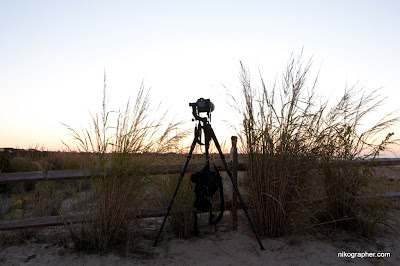


The thing about shooting raptors flying by close and fast though is that shooting from a tripod - that's not so good. I couldn't move around and adjust fast enough. I wound up hand holding most of the time. I'd rest the camera and lens on the tripod, and then when something was approaching I'd hand hold the camera and get ready...
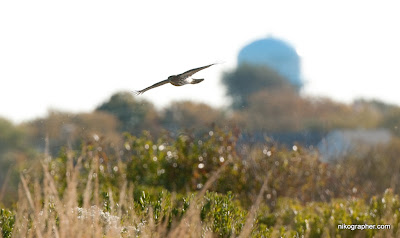


What actually happened next THREE TIMES though was I was too hidden, I blended in too much for my own good. Last year I got a camo coat, and hat, and have wrapped my lens in camo too. So, THREE times at this *other* spot a hawk landed on the fence post, so close that by the time I reached for the camera and began to adjust and move to just begin to PREPARE to take a shot, the hawk was so spooked by my new found presence that it took off before I even came CLOSE to getting a shot. Three times. Once the hawk was just on right of that tall grass perched on the fence maybe 4 feet from me and the camera.

Sigh.

So, I tried to learn from that, expect things, and plan and move around differently... It didn't quite work out, but I think if I had done what I did later during the earlier encounters, it could have worked. So, for me, I learned and will try new things next time.

-

One of the great things about this time of year and Cape May also is that there are so many knowledgeable and friendly people there. In just a few visits this year, I really learned a bunch already. I will still basically say much of the bird IDs I tell people are "guesses" because I know I have so much more to learn, but, with hundreds of raptors passing by, often per hour, I kind of feel like I know more every day of every visit I'm there.


Taking time to blend in, dress right, move slowly, and predict things is something I've picked up more in the past 2 years I'd say. It's like being a hunter... The input influences the output. If you don't know what you're doing the best you can hope for is being lucky. But there more you know, the more you can predict, the more you can steer chance in your own favor.......

Find spots and go with the seasons, learn the lay of the land, patterns, and NEVER be afraid to get info from a local or fellow visitor.

-Jon

Nikographer.com / Jon

Sunday, September 26, 2010

Cape May - Skimmer Sunrise - Shot Details

From http://natureandwildlifephotography.blogspot.com/
I took this one a little after sunrise when the sun hid behind some clouds for a moment.

Cape May - Skimmer Sunrise

Shooting at sunrise (or sunset) really makes for a much better starting point for nice images. The low angle and shadows or side lighting can't be beat. And the warmth of it, and orange light is way better than any mid day light might be.

The bulk of the editing done on this shot were two things. First I cloned out a person that was along the shore and distracted from the light and birds. The eye just wanted to go to it. The second thing I did was to clone out the birds that were partial and along the top edge of the shots. They too seemed to be distracting. There were about 4 or 5 of the bird parts, and the parts you could see weren't enough to make an entire bird out of...

I recently commented that editing (and cloning, etc) for content was something I didn't like or do much. In the case of this image I was ok with it. I don't consider myself a purist on things like this. What ever seems to work or what my eye wants is what I go with. But as a rule I guess, I don't shoot and then edit with a mindset of "hmmm, I wonder which parts I should clone out?" That's not how I shoot/edit.

Nikographer.com / Jon

Thursday, September 23, 2010

Chip! Chip Phillips!

This guy rocks. I don't know who he is yet, just found his flickr stream, but he's top notch and has some amazing photos. I couldn't help but blog a few and spread the word.

This photo is a master piece in my humble opinion. It has light, depth, levels, the eye is just overloaded with wonderful things to view and ponder and enjoy!
Leigh Lake Reflections, Grand Teton National Park

If there ever was a photographer that I noticed, and was like wow, and thought for a moment....

Frozen River, Grand Tetons, closer view

This guy is about LIGHT.

Clements Mountain Sunset

I kind of want to shoot at sunrise and sunset or not at all after seeing these images.

Check out his flickr site and be amazed like I have been so far. I can't wait to explore some more.

Nikographer.com / Jon

Friday, September 17, 2010

Birds Fly South

http://natureandwildlifephotography.blogspot.com/

It's that time of year. It has to be. In just 2 days I saw 2 hawks flying overhead while I was driving. And not in the place or area I'd expect them, just in residential areas right off 2 lane roads.


Hawk mountain had a 1,000+ Broadwinged Hawk day yesterday, Cape May had a 100+ American Kestral/hr day after a storm this week. I even saw 5 ducks at my local little pond for the first time in ages. There's been a kingfisher and a green heron there, but no ducks until this week.

I even have seen a handful of flotillas of Canada Geese flying generally southish.

These Guys Rock

If you are looking for volume of subjects, variety like no other time, this is it. Tons of birds are flying south right now.

I wouldn't consider it snow goose time until late November, and December.
Snow Geese - JX75, A5C6, PM44 (3 pix)Taking Flight


Right now it's raptors, hawks, falcons, eagles, owls, and little birdies like warblers, sparrows, all those kinds of birds and hundreds more!
Looking for the birds @ Hawk Mountain, Pa

Sunrise isn't so early anymore,
and sunset isn't so late.
It's not hot out.
It's not cold out.

Do you like to complain? There's nothing to complain about now.

I'm going shooting!
Female Dark Eyed Slate-colored JuncoMale Snail KiteMagnolia WarblerHawk Hill
nice shot

Nikographer.com / Jon

Sunday, September 12, 2010

Chincoteague NWR, VA pt2

From http://natureandwildlifephotography.blogspot.com/

What's neat about shooting at Chincoteague is getting to see some new behavior.

On a previous trip I was watching the herons and egrets and noticed how the gulls group up with them. The gulls don't seem to bother the herons and egrets much but they do key off of them - some times stealing their catch. What was interesting to watch though was how the gulls imitate the snowy egrets. The egrets will use their feet to stir up the bottom and get critters to reveal themselves. I saw a gull using its feet in the same way, it had to have learned it from the herons and egrets.

Shooting across from the visitors center out near the beach is surprisingly good. I would have thought the traffic or other visitors might detract, but it worked well.


I have this low LL Bean chair, it sits about 4 inches off the ground and makes for a nice seat to use and stay low, and off the sometimes wet/muddy ground.


One thing that I try to avoid is shooting from head high, tripod high, for no reason. Often I will collapse the legs on my tripod to the shortest height and then sit down, or I will extend the legs just slightly and kneel or crouch. I've only gone in to a full horizontal shooting stance a few times, but getting that low makes a difference. The two main things are the angle is more intimate, being closer to the subject, and the other thing it does is makes me less imposing - so I am not towering over a 1 feet subject standing 6 feet tall. Staying low can make a big difference like this. A couple of trips about at Chincoteague I slid closer to a group of herons and got within 20 or 25 feet of them. THey knew I was there but over time I slowly got closer and didn't trigger their fear and they stayed put, hunting, unbothered. When I was done shooting and stood up - every bird flew away. Many came back as I walked away, but that just shows the contrast of standing vs. sitting and the way birds might respond.

This Redish Egret had just caught and ate a crab - and then proceeded to stick its head underwater so it could slowly look for the other bits (legs and claws). It was neat to see and the undisturbed water made for some nice reflections...

Chincoteague NWR, VA


Nikographer.com / Jon